6. Fruit, Leaf and Root Vegetable Guidelines
6.1.3 Peppers – Compost/Manure Technique
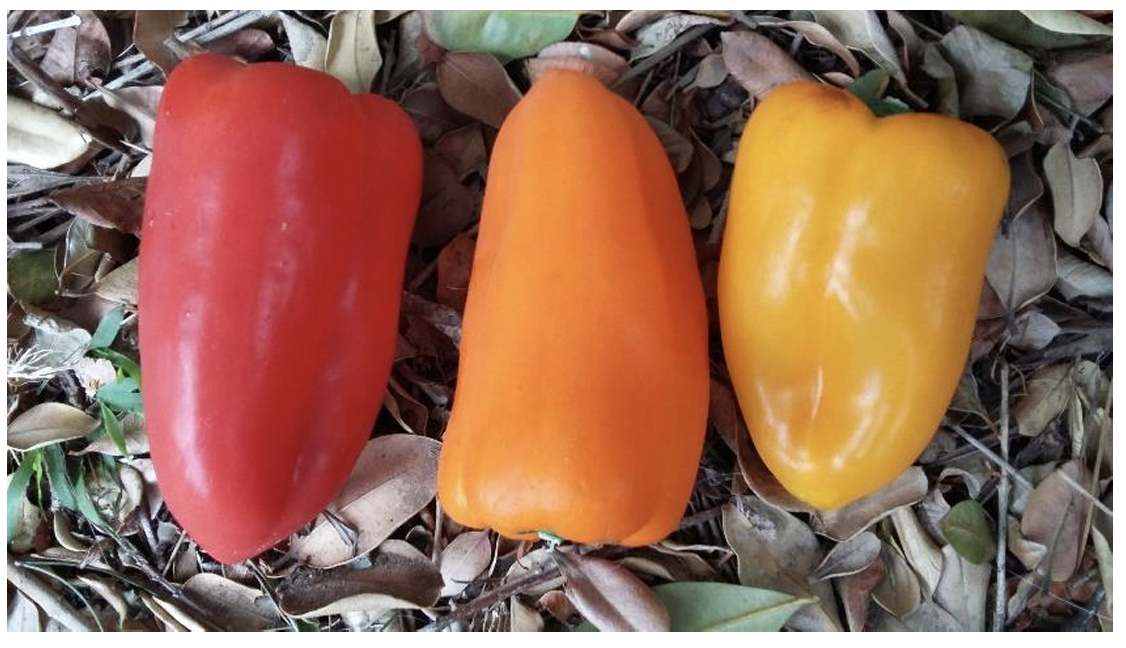
Pepper fruits come in many shapes and colours (green, orange, yellow and red) and are high in vitamin C and anti-oxidants. They are a moderately easy large fruit vegetable to grow, but they are highly susceptible to pests and diseases and need deep, well drained, fertile soils. Peppers prefer a spring or early summer planting time with optimal temperature ranges between 20-27°C.
Layout
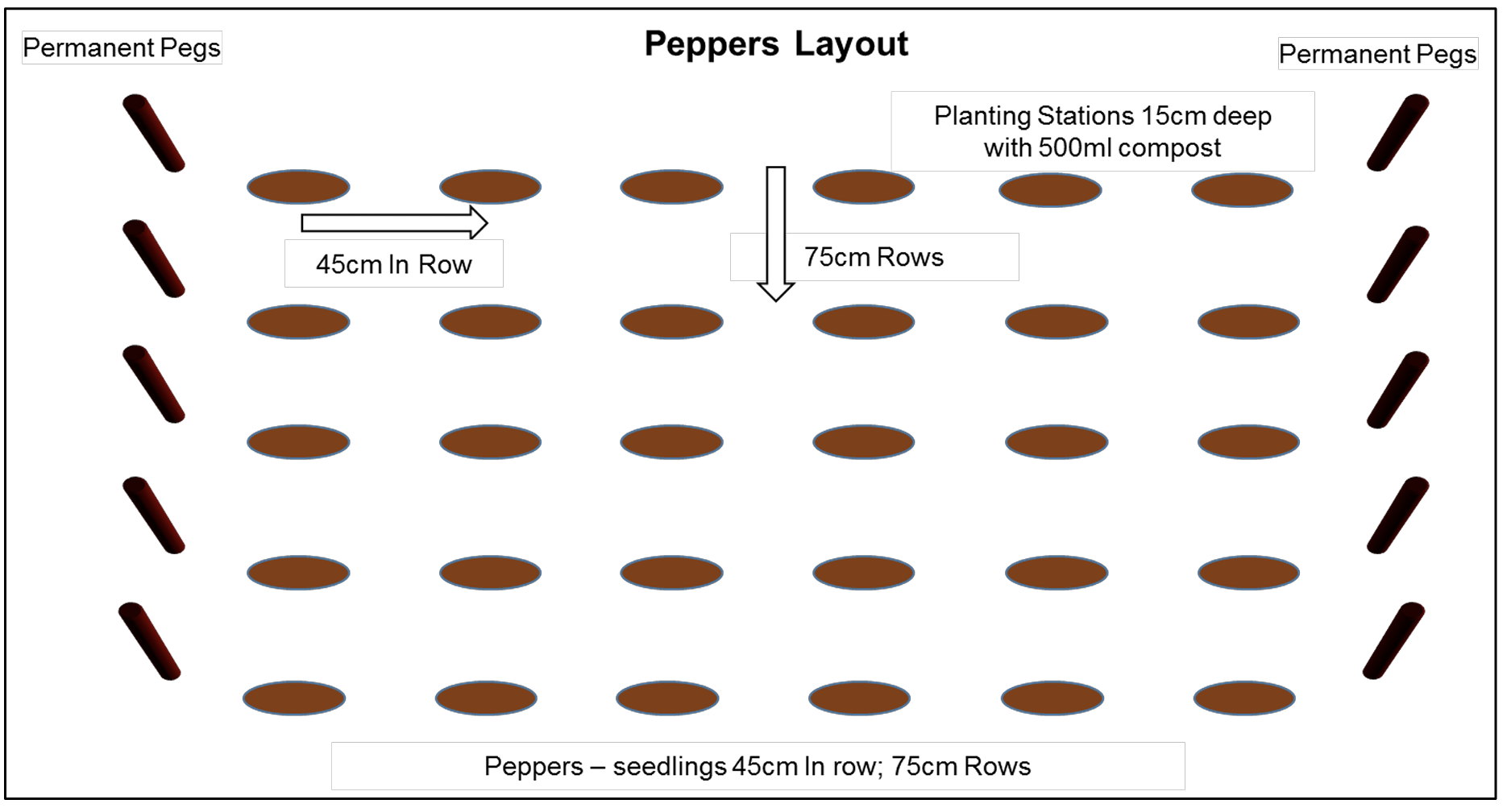
Peppers are planted at a higher population density than eggplant. Plant peppers with 45cm between seedlings and 75cm between rows, similar to cabbages. Pepper plants are vulnerable to lodging towards the end of the growing season, therefore it is advisable to build a trellis network on the row lines for the plants to gain support.
Placing 45cm Measuring Rope
Place a 45cm measuring rope from one 75cm permanent peg to its adjoining 75cm permanent peg on the opposite side. Make sure the rope is taut and straight by lifting and dropping it.
Remove God’s Blanket
Move God’s Blanket 30cm downslope from each planting station to expose the soil.
Soil Fracturing
Give your Peppers a good chance of success by fracturing each 75cm row line to 30cm deep.
Digging Planting Stations
The wide plant spacing make them best suited for inputs placed directly into planting stations rather than surface composting. Dig a planting station 15cm deep at each 45cm interval, moving the soil downslope of the measuring rope, taking care to neatly heap the soil for reuse later. Planting stations should be 12cm wide, 15cm long and 15cm deep. Repeat this every 75cm row interval.
Correcting Acidic Soils
To correct acidic soils and allow for readily available plant nutrients apply 1 tablespoon of woodash/bonemeal or 1 teaspoon of lime, in each of the 45cm planting stations.
Compost/Manure
It is preferable to apply 500ml of compost in each planting station. If you don’t have compost, you should use older, more mature manure as fresh manure results in excessive leaf growth and reduced fruit.
Seed Depth and Soil Separation Layer
Cover all the inputs with soil from the downslope heap until the soil surface is level again. Replace the 2.5cm thick blanket on top of the planting stations.
Planting Seedlings
Twist the dibble stick through the blanket and press it into the centre of each planting station, to the required depth. You must ensure the seedling roots are not bent into a J shape which will adversely affect the plants growth, so make sure the dibble stick hole depth is sufficient but not too deep either. If the hole is too deep, it will cause there to be an air space under the roots which is also not desirable. To ensure you don’t have that, hold the Pepper seedling in place and press with the dibble stick or your fingers at an angle, pressing the soil gently around the seedling roots. This ensures the seedling roots have no bend and ensures that there are no airspaces around the root zone.
Pest Control
Your first line of defence against pests and disease is to keep the plants stress free by having healthy soils, thick mulch cover and an excellent supply of nutrients. Any organic pest management control must focus on prevention rather than cures (See Chapter 5).
All the solanaceous plants, Eggplant, Tomatoes, Peppers and Potatoes are susceptible to similar pests and diseases, so it is critical to have a 2 year break in your rotation planning with these crops.
Observe your plants regularly and if diseased plants have been identified it is often the best option to simply remove those plants and dispose of them far away from the garden.