AGRONOMIC PRACTICE IN RICE PRODUCTION
· For transplanted cropping, choose seedbed site that is easy to irrigate and/or drain, disease-free, and far from street lights. Incorporate 1kg/m2 organic matter before preparing seedbed to make it fertile and to facilitate seedling pulling
· Clean the seeds by floating method. Then, soak seeds for 24h and incubate for 24-36h.
· After incubation, sow the pre-germinated seeds in seedbed at the rate of 1kg per 10 sq m or 40kg per 400sq m seedbed.
· Water the seedbed 2-3 days after sowing or when soil begins to crack. Maintain a water depth of 2-3 cm, and gradually increase it to 5 cm, depending on seedling height.
Direct Seeding
· Dibble at 20 x 20 cm within and between rows at 40kg/ha · Broad casting thinly at 65 kg of seed per ha.
Nursery Bed Operations for Transplanted Rice Site Nursery near your Field
· Choose a fertile area near your rice field.
· Determine the area required to accommodate 50kg (100m2) of seed for 1 ha of land.
· Prepare seed bed at the end of May to early July.
· Plough the land or clean slash before making beds.
· Raise the beds (about 1.2m wide or 1.5 normal walking spaces) to regulate water level.
· Work in to the soil about 60g of urea, 4.2 g of single super phosphate before seeding.
Seeds can be broadcasted or sow in rows on the bed.
· Sow 100g of seed per square meter or 2-3 hand full of seed.
· If in row make row 10 cm apart with wooden planting frames.
· Slightly cover seeds with soil and dry vegetation.
· Keep beds wet (but not flooded) by irrigating regularly.
Transplanting
·Transplant seedlings when it is 21 to 28 old (or 45 leaf level)
·Transplant at 20 x 20 cm spacing (Palm span length).
·Transplanting only healthy good seedlings.
· Water nursery a day before seedlings will be remove for transplanting for ease of uprooting.
· Firmly hold the seedlings at the base to avoid damaging seedling stem.
·Wash the roots and tie in small bundles.
·Hold seedlings between the thumb and forefinger
·Push seedlings in to the soil by digging a hole with the middle finger
·Plant at 5 cm depth to ensure speedy establishment and growth
·Flood the field after transplanting.
· Gap fill the areas where there are empty spaces with remnant of seedlings, 7-10 days after transplanting.
Fertilizer Application
Lowland
·Basal application: 4 bags of NPK/ha before planting
· Top dressing: 1 bag of Urea at 3 to 4 weeks after seeding or transplanting and one bag at 67weeks after seeding or transplanting.
Upland
· Basal application: 4 bags of NPK/ha.
·Top dressing: 2 bag of Urea at 3 to 4 weeks after seeding/planting. Things to note:
At Vegetative Stage
· When applying fertilizer, reduce water level to 2-3 cm, just enough to dissolve the fertilizer. Do not dry the field.
·Use the leaf color chart (LCC) if available.
· Side dress 1/3 of N fertilizer 5-7 days before panicle initiation (DBPI). Apply at 4050 DAS for early maturing varieties and 55-60 DAS for medium maturing varieties.
·Do not drop top dress while the leaves are wet. The fertilizer will stick to the leaves and may cause leaf burn. Dissolved fertilizer will be lost in the air when the droplets dry.
· Do not top dress where there is impending heavy rain because the fertilizer will be washed out in the field.
Keep the fields free from the weeds. Weed before fertilizer application.
Weed Management in Rice Field
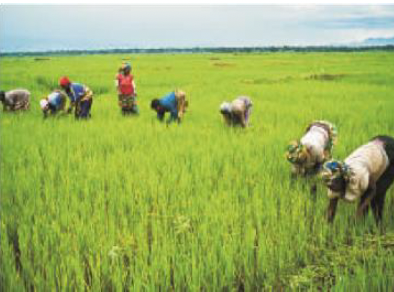
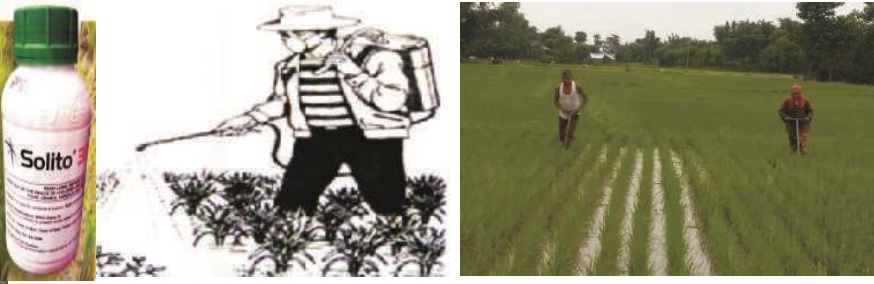
Weed management methods and control with Solito in rice seed production as Post-emergence
Timely control of weeds is critical for high yield and quality, it is therefore important, that:
· Weed management start at 2-weeks after sowing or transplanting even earlier, depending on the level of weed infestation, with a second weeding at 4-5 weeks, and a third weeding at 7-8 weeks, depending on the duration to maturity of the crop and the level of weed infestation. Alternatively, apply pre-emergence herbicides such as glyphosate and sow 2 weeks later, or spray with gramoxone, which is another pre-emergence herbicide and sow 1-2 days later.
· Remember, the use of herbicides in weed management requires some knowledge of the right product for a particular crop, the right time to apply it using the correct dilution. Seek advice from your extension agent on appropriate herbicide types and rates if you are not conversant with their use. Also ensure that the farm is weed-free at all times to get good quality grain that are well filled and will perform vigorously from planting maturity.
Water Management
At 3-5 DAT, irrigate and maintain 2 cm water for wet bed seedlings and 1 cm for seedlings.
During the early vegetation stage, maintain 3-5 water.
PEST AND DISEASE MANAGEMENT IN RICE PRODUCTION Background
· About 15 species of insect are recognized as major pests out of the existing 800 species.
· Because they cause economic damage.
· They are grouped based on the damaged they cause through their feeding habits as
Field Insects
· Stem destroyers (gall-midge)
Leaf destroyers (leaf beetle)
· Flower and grain destroyers (rice bugs)
· Root destroyers (termite)
·Juice suckers (leaf hoppers)
Storage Insects
· The deterioration of rice grains during storage as a result of insect pest may arise if
· The condition of the grain is unsatisfactory
· Unsuitable for safe storage
· Due to insect feeding and infecting the grains.
Biotic and Abiotic Infections
· Any abnormality of a plant or part or products that reduces it economic value is plant disease.
· In a compatible host-pathogen combination disease could be physiological
(invisible).
· Or morphological/structural which is (visible) as symptoms
· Disease could be infections (biotic), fungi bacteria, viruses, nematodes, mycoplasma-like organisms and parasitic higher plants.
· Non-infections (abiotic) caused by various environmental conditions such as low or high temperature, lack of or excessive soil moisture, nutrient deficiencies and mineral toxicities.
Vertebrate Pests
· Vertebrate pests include rodent (tree and ground squirrels, cane rats, rats etc) and grain-eating birds, (Queleaquelea). Village weaver (Ploceuscucullatus), Orange bishop (Euplectesafer). Etc.
Insect Pests of Rice Stem Destroyers
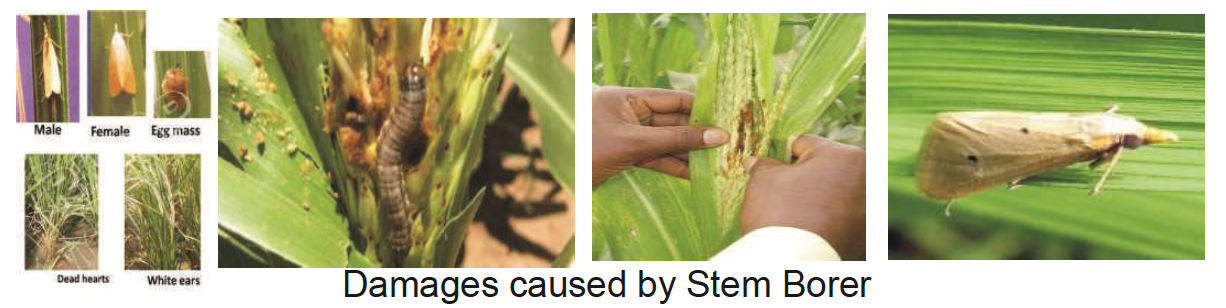
Mode of Operation
· Adult laid eggs on the rice plant.
· Eggs hatch and larva's gain entry into the stem.
· Begin to feed on the soft internal tissues.
· Their feeding disrupts the flow of nutrients from the roots to upper growing part.
· The central growing portion dies.
· If it in at the vegetable stage “dead heart” are seen dead heart.
If at the reproductive stage, the dead upper
portion is the panicle.
· That is whitish in colour – “white heads”.
· They are found in all rice growing.
· Ecologies – upland/inland swamp, mangrove and irrigated rice.
Leaf Destroyers
· Many insect species belong to this group.
· Leaf beetle (lady bird beetle).
· Brown planthopper
· Medium sized and reddish-orange.
· Six black spots on each wing.
· Larvae and adult feed on the outer leaf surface without piercing it.
· Whitish patches without chlorophyll on the leave which eventually dries up.
· They destroy more at the vegetative stage.
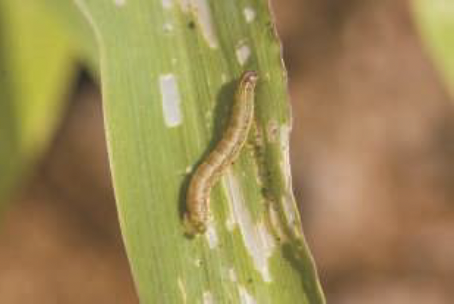
Lepidopterous Leaf Feeder
· The case worm leafhoppers
· More under flooded condition
· Eggs deposited on the marg in of lower leaf.
· Larva forms a case by cutting the leaf across in two places feeding on the chlorophyll.
Armyworm
· Occur occasionally
· Lay eggs on the leaf covered by heirs
· Larvae feed on the leaves causing severe defoliation
· Aggregate in large swamps-hence their common name “armyworm”.
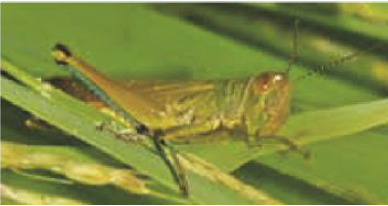
Grasshopper and Locust
· May be short or long-horned
· Lay eggs in masses in the soil
· Nymphs and adults feed on leaves and soft shoot.
· Some gnaw at the base of panicle forming “white heads”.
· They occur in swarms over a wide area, causing complete defoliation.
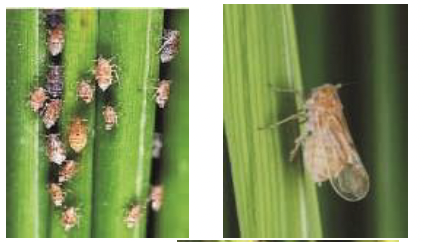
JUICE SUCKERS
Brown plant hopper and leaf hoppers
· Suck the plant and produce large masses of webs on leaves.
· White patches on the leaf, followed by drying up from the tip.
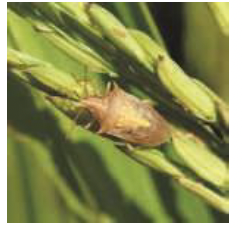
Flowering and Grain Destroyers · Earwig and blister beetle.
· Feed on the floral parts.
· Feed on the rice grains in the milky stage.
· Rice bug cause quantitative yield loss due to weight loss.
· Qualitative loss due to spots on the grain lowering the quality of rice.
Root Destroyers
Termites and Crickets
· Move in the night and cut off roots of rice.
· Very high if there is dry spell for a long when rice are on the field Roots destroyed, plant dies.
· Attack is more on the upland, than low land and irrigated rice.
· Cricket like mole dig shallow tunnels in the ground to feed on roots.
· Like the termites, crickets occur under non-flooded conditions, they are less important than termites,
Recommended Management Techniques
· Adhering to best practices in pest management can reduce any undesirable side effect and hazards to a minimum level.
· These could be applied by selecting a combination of the most efficient and cost effective technique available (integrated pest management).
· The choice of these integrated measures will depend on economic, type and size of farm, conditions prevailing in the area and the future use of the commodities.
· Synchronized planting can evade pest infestation. During the early growth stage of the crop (30-40 DAT), it is not necessary to spray pesticides against leaf feeding insects, as the rice crop can compensate for leaf damage.
Cultural Control
- Plant early
- Plant early maturing varieties
- Plant simultaneously in a district to reduce the population of certain insects.
- Flood the field to reduce the population of some insect pests e.g armyworms. - Weed at appropriate time.
- Burn straws and stubbles and plough into the soil.
Varietal Resistance
- Plant rice varieties that inherently attract relatively fever insect species and suffer less damage.
Biological Control
- Rice insect pests are attacked by numerous parasite, predators and pathogens.
- Avoid use of much broad-spectrum non-selective insecticides.
Chemical Control
- Insecticides are chemical compound used to kill insects
- Use them properly, they are harmful to human being.
- Active ingredients and the dilutent of the chemical
should be known before they could be applied in either.
Solid Form
· Dust or power without the need for water e.g Aldrin
· Granules – small solid particles used for broadcast e.g Furadan.
Liquid Form
· Wet table power – a wetting agent is added so that it can stick to sprayed surface.
· Emulsifiable concentrate (EC) the active ingredient is mixed with an appropriate solvent as a carrier together with an emulsifier.
Weeds Management
· Apply pre-emergence herbicides 0-5 DAT, if unable to prepare land thoroughly. Pull the weeds that are resistant to herbicides.
Using Herbicides
· Drain water from the field.
· Apply Glyhphosate as pre-emergence two or three weeks before seeding or transplanting at 4 liters per ha in 120 litres of water.
· Apply propanil plus 2-4 D or Orizo plus as 3-4 weeks after seeding or transplanting at 4 litres per ha.
· Hand weed again around 40 days after transplanting.
Common Rice Disease
Rice diseases of economic importance that need careful attention for increased productivity in farmers' fields are as follows:
Disease Causal Organism
Rice blast - Magnaportegrisea
Rice sheat blight – Rhizoctoniasolani
Brown spot – Cochiobolusmiyabeanus False smut – Ustilaginoidiavirens
Grain spotting and pecky rice – many fungal species and bacteria Leaf scald – Gerlachiaorysae
Narrow Brown Leaf spot – Cercosporajansaena Sheath rot – Sarocladiumorysae Root knot – Meloidagnane spp.
Bacterial blight – Xanthomonancampestrispv. Oryzae
Bacterial leaf streak – Xanthominancampestris PV oryzicola