AGRONOMIC PRACTICE IN RICE PRODUCTION
Background
The rice post-harvest system concept is an efficient, modern approach that focuses on preventing post-harvest losses and ensuring the quality and safety of the rice crop during its processing, marketing and storage. The rice post-harvest activities are the final operations in the cropping calendar and is very important that they are carried out carefully as it is essential in the overall farm management plan, and because postharvest losses (both qualitative and quantitative) are critical and reduce yield increase due to increase in hectares.
Basic Learning Objectives
It is expected that at the end of all the modules trainee will be able to:
· Discover good post-harvest and processing practices.
· Exchange information on post-harvest operation and rice parboiling.
· Discover operations in the rice post-harvest that will be considered as critical control point (ccp).
· Understand production branding and packaging for rice.
· Have enhanced knowledge good practices on rice parboiling technologies.
Procedure
While organizing training using this module and for maximum impact, the following procedures are necessary.
· Discuss farmers' post-harvest practices areas where practices are in line with recommendations and also where it is not.
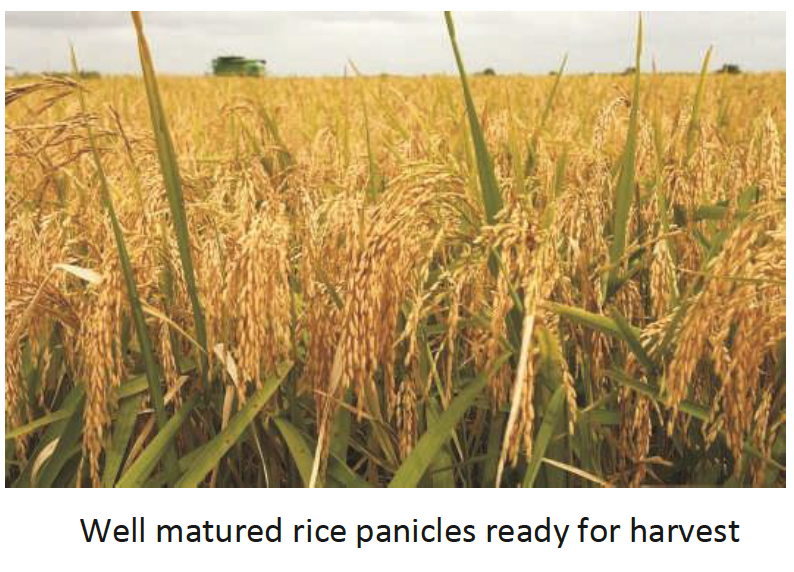
· Facilitator or instructor launches debate on good post-harvest management and processing practices beginning with harvesting operation. Emphasizing best harvesting period, when at least 80% of the grains have turned yellow and the remaining 20% has reached dough stage; grains are clear and hard when dehulled and consequence of late harvesting: losses due to rodents, birds and shattering.
· Discuss the importance of drying harvested panicles, threshing winnowing as soon as possible after harvesting to ensure good grain quality.
· Take primary post-harvest operations one after the other and interactively discuss with farmers recommended good practice, highlighting possible area where loss may occur and possible remedy.
After carefully reviewing the primary post-harvest operations, initiate discussion on Secondary Post-harvest Operations (parboiling, milling, packaging and marketing).
· Initiate debate on good parboiling operation, allowing each trainee to say and agree on common practices, before introducing the importance of parboiling, good practices and step-wise operations that will enhance the recovery of high head rice and low broken rice.
· Introduce cost saving operations that will make rice processing competitive such as the use of fuel efficient vessel and stoves, agro-processing waste to fire vessels, proper cleaning to reduce foreign materials etc.
· Introduce the concept of rice packaging, its importance, and strategies for branding and marketing.
· Finally review the good practices outlined for the primary and secondary postharvest operations. This should be done by each farmer explaining what he or she has learned during the training and also highlighting what need to be changed in his usual practices.
· Encourage sharing of such information with other farmers within the same community or cooperative.
· Also help lead farmer or farmer's leaders to have all basic steps clear as he/she will step the training down at village level where extension officer is not available.
Recommended Harvest and Post-Harvest Operations · Rice is mature when 80% of grains turned straw colour.
· If the field is still flooded, remove water and leave the crop to dry to 18 to 20% moisture content.
· Harvest and thresh if dry.
· Thresh on concrete floor or tarpaulin, or dry threshed paddy on concrete floor or machine drier to avoid stones and gravels.
Things to note
Harvest paddy when 80-85 percent of the grains are mature. Grains at the tip of the panicle must be hard and golden yellow, even while grains near the base of the panicle are less mature. Delay in harvesting will cause the grains at the tip of shatter.
Generally, draining of the field be done 2 weeks before harvest. However, depending on soil type, gradually drain the field up to saturation point, preventing abrupt drying of the soil as this will affect grain quality. Harvested palay must be threshed immediately to minimize field losses and grain quality problems.
Thresh, clean, and dry grains immediately to 14 percent moisture content, or lower before storage.
How to observe the paddy field in order to determine an optimum harvest time?
1) Observe your field to notice when the panicles, not the rice plant starts getting yellowish in appearance. Do not confuse the colour of the straw with the yellowish colour of the panicles. Yellowish colour of the straw may result from early senescence of the leaves.
2) Pay attention to the panicles and observe when individual panicles in different parts of the field, have up to 80% maturity in the upper part of the panicle.
3) Waiting for the remaining 20% to mature may lead to shattering of the upper grains, which are very often better filled, thus, resulting in yield reduction.
Threshing
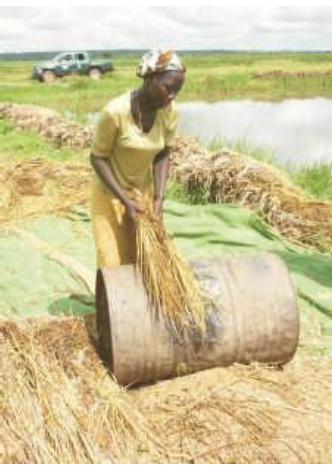
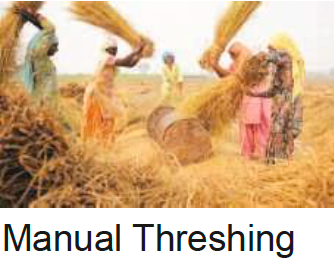
In manual threshing several methods are available. In some places threshing is done using legs to march on the straw, others beat the straw against drums, others put the straw in bags and beat it against tree trunks, stone etc while others use sticks to beat rice straw heap. This method is time consuming, labourious, slow and output is quite low. Contamination of paddy with sand, stone,
immature grain and other foreign materials is high. There is also loss of grain leading to reduction in overall yield.
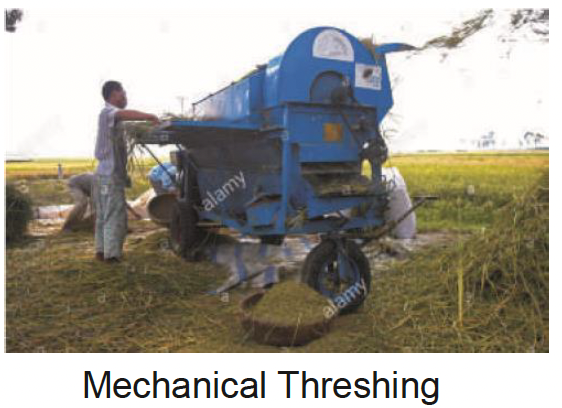
However, there is an intermediate technology for rice threshing that is adoptable to small farm size and with efficient output. These threshers are either semi motorized or completely motorized. These are already available in several places in sub-Saharan Africa, particularly in irrigated areas or developed low land.
The thresher provides clean paddy without damaging the grain because of its axial flow system. Straw are chopped into and discharged as waste which may be collected and preserved for animal feed or incorporated into the soil to improve soil fertility. It is easy to be operated by both men and women.
This to note
· In the use of motorized threshers, there is need to have adequate knowledge on the adjustment of the motor and air velocity.
· It provides opportunity to gather chopped straws for animal feds and no winnowing after threshing.
· Initial cost of production may be slightly high for single farmer, but cooperative may buy and use it as income generation venture.
Cleaning Manual Cleaning of paddy
In manual winnowing the threshed materials are thrown up along the directions of flow of the wind, blowing away all the chaff and lighter materials. Material of the same density as that of the rice grains are also retained. The process requires much labour, is slow and low in output.
Mechanical Paddy Cleaner
Also available are mechanical winnowing blowers and cyclone. With hand operated blowers, the operator winds the machine to generate a centripetal force which separates the grains from the chaff. The grains drop to the bottom while the chaff is blown out through
the exhaust. This has a larger output than the manual winnowing and the problem of recontamination is eliminated. The motorized winnowers operate the same way but have increased output. They are however more expensive and are limited in availability. There is also the problem of the cost of fuel, maintenance and spare parts.
Things to note
1. Use a clean surface, plastic sheets, tarpaulin etc when cleaning paddy to avoid contamination with sand and other extraneous materials that may reduce the quality of rice.
2. Clean the machine after cleaning one variety before introducing a different variety, especially if rice processed for seed.
3. For efficient manual cleaning always stand where the wind speed is minimal not to allow blowing away of good grains.
4. When water cleaning is used especially during parboiling, stir properly and don't pack the bottom sediments.
Rice Drying
The major objective of rice drying is to reduce grain moisture content to a level that will meet the recommended levels for safe, long term storage and milling operations.
Depending on the ecology, rice drying in Nigeria is by direct sun light. The extent and efficiency of the operation depends on the sun and general weather conditions. Paddy therefore, dried under high intensity sunlight for a long time may develop cracks and on processing result in high level of broken grains. Rice are dried on bear grown, on high way sides, on mats etc., most of these drying facilities expose the grains to contamination and loss due to spillage, animal consumption and wind.
Transportation
In most developing and least developed countries like Nigeria that produce rice, conveying harvested paddy from the field to processing, marketing or storage areas are mainly be means of human and animal power and sometimes mechanical power with the corresponding devices, tools and equipment. Small and family-sized volume of paddy is transported in bags from the house storage to the small rice mill by foot, bullock carts, bicycles, motorcycles, small-sized vehicles, or public transport vehicles whichever mode is available and affordable. Where paddy is field threshed, men usually carry the 40-75kg bag of paddy on their shoulders or back from the field to the nearest road.
Paddy Storage
1. Clean grains by winnowing before storage
2. Store paddy at about 13% or less moisture content
3. Use bags or other small storage facilities.
4. Avoid moisture fluctuation, wetting and drying for good grain quality.
5. Store in dry sheltered condition.
What to note
1. The warehouse should be properly treated and disinfected before introducing the paddy.
2. Storage room should be well ventilated with windows facing north to south as this will avoid direct penetration of sunlight at dawn and early evening.
3. Always place paddy bags on a wooden pallets and place pallet at a 40-50 cm from the wall.
4. Warehouse window should be left open, and therefore it is advised that the windows be located slightly higher above the normal window position.
5. When several batches of paddy are stored, they should be removed on the principle of first in first out.
6. During long storage, store room should be disinfected with storage chemicals or other appropriate physical means.