Land Preparation and Planting
This section covers planning an appropriate population (including spacing/ layout design) and planting methodology.
These elements are closely interlinked as choice over spacing and layout of plants directly impacts the overall plant population that can be achieved in a given area. To achieve an optimal yield, any decision with regards to population and spacing/layout must be made in light of the fact that plants compete for resources (nutrients, water and sunlight) and must be accessible for plant management practices to be completed. For smallholders it is advisable to use wider spacing.
SPACING AND POPULATION
Planting population or density (i.e. number of trees in a given area) will likely be influenced by a range of factors including:
Size of the mature coffee tree – larger trees require a lower density.
Feasible level of maintenance– higher density will mean more maintenance.
Use of fertiliser– fertilisers boost tree growth so a lower density is required. 8
Manual versus mechanical maintenance.
Chosen field layout and spacing (explored further in the proceeding sections).
Studies have shown that the optimal density for Arabica coffee in high–altitude equatorial zones is between 2,500 and 3,300 trees/ ha. Nearer to the tropics the density is generally between 1,100 and 1,600 trees/ha9.
An important layout decision to make is whether to plant in covas or single hedgerows. For more information about planting in Covas or Single Hedgerows refer to Simply Coffee10 or section 7.3.3 Density of Planting.
TABLE 4. SUGGESTED DENSITY, LAYOUT AND SPACING FOR ARABICA
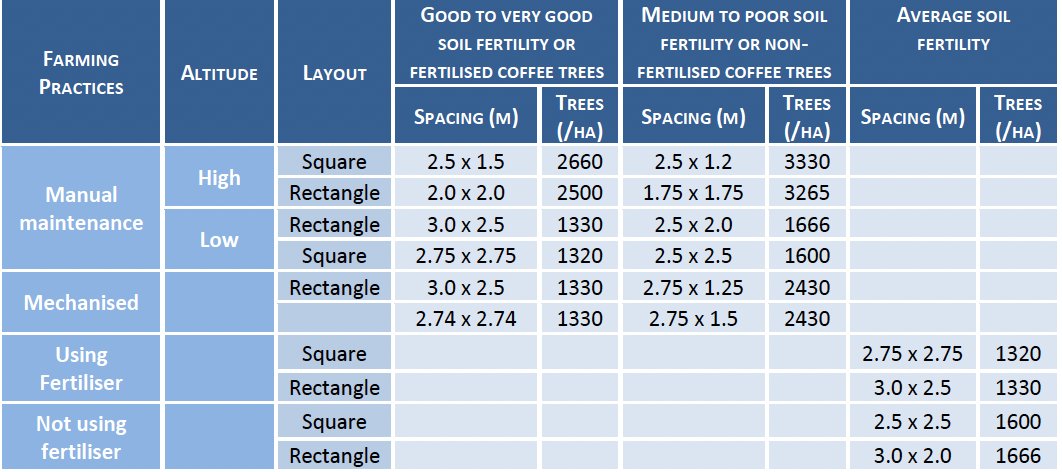
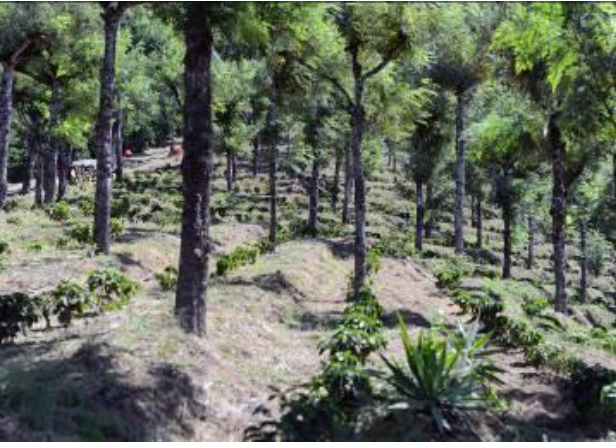
FIGURE 7: GUATEMALA CONTOUR PLANTING UNDER SHADE
CONTOUR PLANTING
When a coffee plantation is on land with a slope of more than 5% the coffee trees should be planted along the contour (coffee rows should run at right angles to the direction of the slope). Anti-erosion measures such as contour ridges, contour bunds, contour ditches and vegetative measure of erosion control also run along the contour between the coffee rows in order to manage the rainfall run-off13. Contour planting is recommended for conservation and other management considerations such as energy use when spraying and more even application of water via irrigation systems.
ORIENTATION
If the terrain is relatively flat or the general contour configuration will permit, an approximate NorthSouth orientation allows a degree of mutual shading in the middle of the day and a similar distribution of height on both sides of the tree. Alternatively, to protect the tree from excessive sun in the afternoon an east-west row orientation is preferable.
WINDBREAKS
Coffee trees can be harmed by consistent exposure to strong winds and therefore it is important to shield the trees using windbreaks in areas that are wind-prone. If breaks are not naturally provided by vegetation, trees may need to be planted intentionally. The windbreaks must be planted at least 15 metres away from the coffee and should be grown in a row that is planted across the slope and perpendicular to the prevailing wind direction. They should be planted in the few years prior to planting coffee and should be allowed to grow higher than shade trees. Considering the length of time it takes for windbreak trees to grow to full maturity it may be sensible to plant alternative intermediary solutions (fast growing biennials or perennials in the meantime). The selected trees could include a mixture of short and tall trees to ensure a successful barrier is achieved. Pine trees, Gum trees and Cypress trees tend to deplete the fertility and water of the soil so it is not advisable to use these in close proximity to coffee.
ADVANTAGES AND DISADVANTAGES OF WINDBREAKS
Advantages:
Evapotranspiration losses can be reduced by up to 33% in sheltered coffee (stops trees drying out).
Large fluctuations in temperature are buffered.
Humidity within the trees maintained at a higher level.
Prevents leaf scorch and physical damage.
Some windbreaks may generate additional benefits e.g. fruit, mulch material, firewood.
Disadvantages:
Coffee close to windbreaks may suffer from competition for light, moisture, nutrients.
Area used for windbreaks is lost for coffee production.
May cause an increase in the difference between air temperature at the farm during the day or at night.
High and dense windbreaks may become an inconvenient obstacle if certain kinds of management procedures are used.
SHADE TREES
In its natural environment coffee is a shrub which grows in the forest under the canopy of other trees and until around 40 years ago the majority of farms grew coffee under shade. However, in recent years new varieties of coffee have been developed for commercial growers which will thrive under full sunlight conditions with the intended advantages of increasing coffee yields and reducing the risk of fungal diseases especially of coffee leaf rust (Hemileia vastatrix). Therefore today, there is more of a debate about the necessity of using shade trees and it is generally considered important to make the decision based upon the conditions specific to the farm because in good coffee growing conditions the negative impacts can outweigh the advantages. However, global warming presents a risk to status quo temperatures and sunlight conditions for existing stock, and shade trees can be included in a climate-smart model.
Advantages and Disadvantages of Shade Trees are listed in below.
Advantages:
In areas with higher than optimum temperatures, shade trees protect coffee from high solar radiation and limits evapotranspiration.
Limits weed growth.
Reduces decay rate of organic matter in soil.
Reduces plant metabolism encourages more regular flowering.
Higher populations of birds and other predators associated with the tree cover introduces natural pest control (such as of the coffee berry borer and leaf miners) and increases the number of bees to improve fruit set (following pollination).
Shade trees will help to stabilise soils in coffee plantations, reduce soil erosion and reduce water runoff all of which are beneficial for coffee production and reduce the risk of catastrophic crop failure.
Shade-grown coffee typically has higher diversity of flora and fauna.
Organic coffee has to be shaded.
Bean ripening is slowed therefore improving bean density and cup.
Enriches the soil through increased organic material (leaf fall/ twigs) and hence reduces dependency on chemical inputs.
Some leguminous trees are nitrogen fixing.
Protects against extremes in atmospheric and soil temperatures.
Provides increased protection against frost and strong winds.
Reduction of Cercospora spp. and attacks by White Stem Borer.
Contributes to conservation of biodiversity.
May generate additional benefits e.g. fruit.
Improved quality through slower ripening.
Reduces the effect of biennial bearing.
Disadvantages:
Competes with coffee for nutrients and water.
Require regular lopping and thinning which is labour intensive.
Branches may fall due to lopping or high winds and damage coffee below.
Shade reduces photosynthesis activity and causes elongation of inter-nodes both of which result in lower yields.
Risk of Coffee Leaf Rust (CLR)
Considering shade for temperature and moisture maintenance, with controlling risk of Coffee Leaf Rust (CLR), is a balance.
The chosen shade trees need to:
Provide a homogenous canopy with few gaps and no undue leaf density.
Intercept 20-45% of total light falling on the plantation.
Must be deeply rooted, wind resistant, long living and fast growing.
Well adapted to local conditions.
Preferably provide consistent coverage year round.
Must be able to withstand intensive pruning to provide organic mulch material.
Must make sure selected trees are not host to pests.
Arabica coffee requires more dense shade coverage as compared to Robusta coffee. Shade trees should be planted at least one year before the coffee is planted, if possible.
Common species that are used as shade trees in coffee include:
Grevelia: very good for timber and firewood, wind break on boundaries (12m X 12m)
Leucaena: fast growing, nitrogen fixing, rich animal feed, good biomass (4m X 4m)
Albizia: improves soil fertility, nitrogen fixing, biomass
Calliandra: fast growing, good firewood and fodder, nitrogen fixing, heavy leaf litter
Glicidia: fast growing, nitrogen fixing and biomass
Kenya Croton: fast growing and supplies a lot of litter for mulch
INTERCROPPING
Intercropping can be short-term (i.e. in the 2-3 years preceding the first harvest or in the 2 years following stumping of old coffee trees) or permanent (farmed for the duration) depending on the farmer’s requirements. Temporary intercropping should be avoided if slopes are very steep (as it will encourage erosion), soil has low fertility, the chosen crop will host coffee parasites, the chosen crop will provide undue shading to young coffee plants or if soil nutrients extracted by the intercrop are not replaced through fertilisation.18
It should also be noted that planting other crops close to coffee lines can deplete soil moisture so the separation distances should be planned in advance and managed accordingly.
The choice of what intercrop to choose is made according to local climatic conditions, purpose of the inter-crop (permanent or temporary), the size of the farm, availability of the necessary resources and access to a stable market.
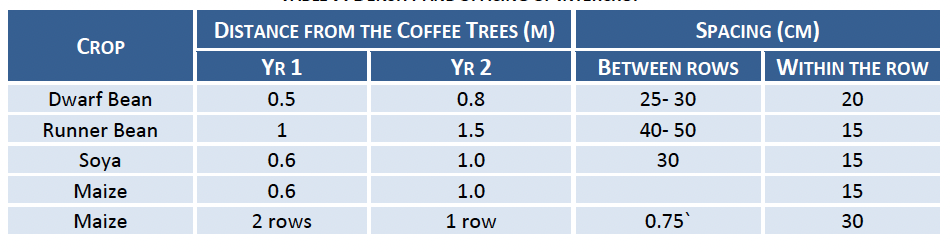
Temporary intercrop options would include plants such as Maize, bean, soya, cowpeas, Suggested spacing given this range of crops is given in the table. Cassava and potatoes have been thought to have an adverse effect on coffee growth.
TABLE 7. DENSITY AND SPACING OF INTERCROP
Permanent intercrops could include Banana in the inter-row, or forest trees (planted in between the coffee trees in alternate rows to shade trees). Forest trees may be considered more suitable than fruit because they require less maintenance and provide less competition.
Soya beans
The main complication is that the coffee requires irrigation during the drying off period for soya. However, coffee can be irrigated by hose and basin and the soya can be cut and dried away from any sprinklers.
Field Beans
In some situations it has been noted that field beans should not be planted earlier than late February to avoid aggravating any frost problems, however this should be confirmed either through CAMAL or in discussion with other farmers in the area to confirm prior to choice of crop.
Maize
Maize has been trialled in hotter low yield areas as it can provide temporary shade during the early establishment period. Maize leaves should be removed where they are liable to chafe developing coffee leaves.
PLANTING OUT
Good planting practices ensure good drainage and also reduce the risk from disease and ground frost. As it is such an important task planting amounts to 80% of the major work because, as a result, all other operations fall into place. To achieve a good result all of the planting team must be clear on the chosen method before it commences. Once a decision has been taken on spacing, the land should be marked out with pegs. A string or measuring stick can be used to indicate the peg positions depending on the evenness of the ground. On slopes the method highlighted below should be used.
Best results are obtained from planting out early in the season (July to August with irrigation). Practices which conserve moisture (e.g. autumn ploughing) are important if undertaking early planting.
The most appropriate equipment to use is a tractor ripper that will rip a straight coffee line. The tines of the ripper can be spaced according to the plant spacing. This will give good drainage and aeration to the plant. A hoe can be used to make the holes. A sharp and sufficiently long knife may be required for cutting plant roots.
When the plants are ready to be transported from the nursery to the field care should be taken. If it is very hot a wet hessian shade may be required. The pots must be wedged in tightly to avoid damage.
The suggested method for contour planting (at a spacing of 2.5 m x 2 m apart)
1. Mark the planting holes out by:
a. Constructing a simple “A-frame” structure measuring 2 m high and 2.5 m wide at the point where legs are furthest apart. The horizontal support cross-piece should be marked at the central point. A string with a weight (e.g. stone) should be attached to the top of the A and allowed to hang freely.
b. Starting from the bottom of the slope, “walk” the “A-frame” across the slope by rotating it from one leg to the other.
c. Place a marker at each point on the ground where the pendulum lines up with the centre mark on the horizontal bar. Continue for the desired length of the contour line.
2. Locate the next contour line 2m up the hill from the first row.
3. Continue this procedure until the entire field has been marked out.
PREPARATION GUIDELINES
The instructions explained here should be used as guidelines only as there are other methods of preparation. Please consult the wider manual or other manuals for alternatives depending on location, topography, soil and varieties.
1. Dig the 40 cm area around the pegs marking out planting layout, mix the soil with the fertilizer, lime and manure, and then heap the soil around the peg like a molehill. This allows it to settle firmly into the rip line.
2. Add phosphate and/ or lime as recommended by the soil analysis in the topsoil and put some of the topsoil at the bottom of the holes 4-6 weeks before planting.
3. Planting holes should be dug ½m X ½m two months prior to planting out. The top soil must be put on one side of the hole and sub soil on the other side. The fertilizer, compost, manure, lime (if necessary) should be incorporated into the top soil and well mixed and fill the hole with the top soil using the peg to mark the centre. The sub soil can be spread on the outside. At planting a hole can be dug to fit the pot.
8.7.2. PLANTING GUIDELINES
The instructions explained here should be used as guidelines only as there are other methods of planting. Please consult the wider manual or other manuals for alternatives depending on location, topography, soil and varieties.
1. Plant coffee trees 2.5 cm above normal ground level.
2. Cool wet conditions are most suitable. In the absence of suitable weather, planting should take place only in the early morning and late afternoon.
3. The soil in the pots should be well soaked before planting and bent tap roots should be cut off above the bend.
4. Topsoil should be used to infill and subsoil used to scatter over the soil surface. Firm in the soil around the plant with hands.
5. Make a large (0.5 m radius) basin around the plant by pulling up soil.
6. Place a ring of mulch around the tree immediately after planting which should not be in contact with the stem of the plant. Ideally the entire row would also be mulched to reduce erosion and conserve moisture.
7. Apply an insecticide at monthly intervals to protect plant from dusty surface beetle and cut-worm damage.
8. A pre-emergent herbicide could be applied in bands down each side of the row.
9. Water plants as soon after planting as possible. Following this, be careful not to over-water young plants (a little and often is all that is required). If irrigation is available, irrigate as required.
10. The plastic pot should be placed on top of the peg which marked the planting station as this shows the pot has been removed.