Nursery Practice
NURSERY PRACTICE
Nurseries are used to ensure that significant quantities of disease free and true to type coffee seeds are available at the required time. This supply allows for planting to take place at the correct time and for a variety to be introduced into a new location. Good supervision and management is a prerequisite for a successful nursery on the farm.
THE NURSERY
To ensure ideal conditions for coffee growth there are some requirements for the nursery site and soil.
NURSERY SITE REQUIREMENTS
To be fenced and protected from cold air.
Suitable clean water available on site.
Allow 5 m around the edge as a firebreak.
50% shade (top of the side walls covered and the bottom side left open for airflow). Do not use green shade netting as this can increase temperatures excessively.
Avoid areas known to be susceptible to frost.
SOIL REQUIREMENTS
Only use fertile free draining topsoil (top 25 cm).
Use sandy/loam to sandy/clay/loam.
Virgin soil has a higher organic matter content and is free of eelworm. Do not use soil from tobacco, maize and banana lands or vegetable gardens.
Add well-rotted compost or manure to poorer soils: 1 part to 3 or 4 parts soil by volume.
Harrow or mix in additives and sieve through a 5 mm x 5 mm mesh screen.
Use a funnel with a 12.5 cm diameter spout to fill the pots so that when the soil settles after a good watering there is a 5-10 mm lip above the settled soil. 1 m3 soil fills 300 pots. The pots must be tampered to reduce air pockets before putting in the nursery bed; this also helps to keep the pots upright. There should be a maximum of 10 pots in a line for ease of management and support the edge of the bed with bamboo, soil or off cuts so pots do not fall over.
SEED SOURCING AND SOWING PRACTICES
Seed sourcing and sowing practices are currently a problem in Malawi and there is no certified seed in Malawi. CAMAL should be contracted for any requirement of seed. The supplier of seed should be visited and check the seed plot to ensure that the seed supplied is of a high standard.
A guideline on how to set up a seed plot on the farm can be found in Annex 3: A Guideline On How To Set Up A Seed Plot.
SOURCING SEED
Authority from CAMAL is needed to move seed (this system is used to reduce the spread of disease). Seed should be sourced from Registered Seed Growers List (SCEO or CAMA). Seed must be fresh when it is used and is only usable when it is less than 4 months old so it must be used within one season. Source seed is available from May-September but the beginning and end of the season should be avoided. Allowing for contingencies, 3kg of seed (assuming 4,000 seeks per kg) per hectare of land is required at the recommended spacing. However, 1,500 covas per ha require 1.5kg of seed or 2,000 covas per ha require 2kg of seed. To control Fusarium Disease, the seed may require a treatment of 1g Benglate (benomyl) per kg of seed (if it has not already been treated).
SOWING REQUIREMENTS
Sowing the seed requires good conditions for germination
Timing
Below 1,000m: September/ October sowing seed for planting using, irrigation the following July/ August.
Above 1,000m: August/ September sowing for planting using, irrigation the following July/ August.
Planting in rainy season: December/ January for planting in November/ December. February can be too wet. Check the seed reaping date for viability.
Materials and layout for Sowing
Pots are preferred to sleeves in general.
Pots should be 25cm x 20cm lay flat or larger.
They should be well perforated at bottom.
Each bed should comprise 50 x 10 pots 1.3m wide and 6.5m long.
Sowing Method
1. Remove any weeds.
2. Ensure soil level in pots is 5-10mm from the top lip.
3. Place two seeds flat side down on soil surface of each pot near centre of pot and 2.5cm apart. Do this on the entire bed before covering with soil.
4. Push seed down 1cm below soil surface.
5. Cover with soil in the pot and firm gently with finger and thumb or add dry soil and press down gently if soil in pot is wet.
6. Water well after planting.
7. Mulching: Cover the soil surface of each pot with a light and fine grass mulch such as lovegrass - Eragrostis chopped into 2 cm lengths. Ideally the mulch should be sprayed with Confidor to prevent ants.
Watering
Equipment: Use a watering can or hosepipe with fine rose or microjets suspended above each bed. The decision should be made based upon the size of nursery.
Sowing to germination: A light watering daily and a good watering (soaking to the bottom of the pot) once per week.
Following germination: Water less frequently but apply a good watering on each occasion. After watering the pot should be soft from top to bottom. Before watering the pot should have dried out and be becoming hard to the touch. Moss at the surface suggests over-watering and/or nursery may be too dark and damp.
FIGURE 3: EXAMPLE OF NURSERY
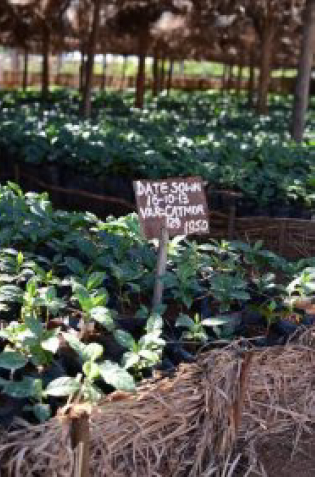
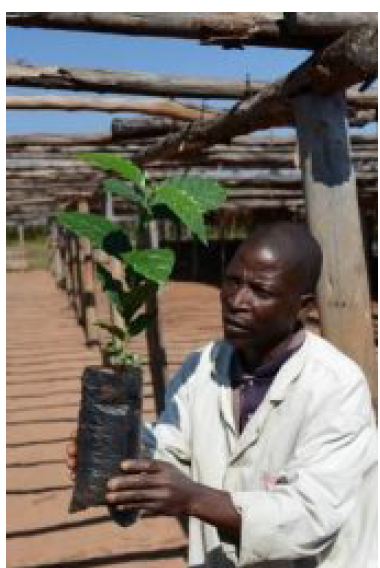
FIGURE 4: SEEDLING READY FOR PLANTING OUT
SEEDLINGS
Fresh seed takes 6-8 weeks to germinate. You should always be watching for and removing weeds and you should scout daily for pests and diseases. Chemical control/ prevention could be used however chemical use should try to be avoided if possible. Two weeks prior to planting out drench with Confidor insecticide as per recommendations. Make sure that beyond 12 weeks there are no more than two plants per pot to ensure the plants grow at optimum rate but at first and second pair of true leaves, thin to one plant per pot and commence fertilisation. Before planting out plants should be 20-30 cm tall and 4-6 weeks before shade should be removed progressively. Any plants that are not true to type or are unhealthy should be discarded.
Pests
Cutworm and dusty surface beetle: Use soil drench of a synthetic pyrethroid (e.g. Karate), or Thiodan 50WP.
Slugs and snails: Use slug or snail bait, snail pellets such as Mersurol, or powdered tobacco scrap.
Nematodes: A nematicide (seek latest available safe nematicides). If nematodes are seen in the nursery the affected plants should be removed.
Disease
Fungal infections: At cotyledon stage commence regular application of fungicide. E.g. Spray Kocide monthly at a rate of 100g to 15 litres of water.
Fusarium: If Fusariam or Cercopora is seen, reduce water and immediately inform seed supplier. There is a very high possibility that it is seed borne and the quality of seed is compromised and suspect. In this case it should be destroyed.
Dampening off: 90g of Baytan should be sprayed once and Thiram (60g to 15litres of water) should be sprayed weekly for 4 weeks. Thiram could be used in the 12th-16th week as a preventative measure.