Mulching
MULCHING
In its natural environment coffee grows in a bed of forest litter. Its superficial root system is therefore adapted to function most efficiently under such conditions. On commercial farms we attempt to simulate these conditions by keeping the bare soil permanently covered with a layer of organic mulch material.
Mulch is most beneficial when done to trap soil moisture and to keep soil cool during the hot summer months. This could be done as the seasonal rains recede in February.
10.1. ADVANTAGES
Mulching is considered essential at least for the first two or three years in the land because:
It improves the yield: It facilitates better regulation of moisture levels in the soil, thereby increasing soil moisture retention and improving surface water infiltration into the soil. The yield response to mulching coffee is greater for coffee grown on lands with steep slopes, shallower soils, coarse textured soils or soils with a crust or capping problem than from coffee grown on flatter, deeper, heavier textured soils. Such problems relate mainly to moisture conditions in the soil.
Costs of irrigation are minimised: Because mulching reduces the watering requirements.
Protects the soil surface from erosion.
More vigorous top growth and productivity: Encouraged because building the topsoil fertility develops additional surface roots.
More economical and efficient of costly fertilisers: These are conserved by mulching due to reduced surface run off and easier access to roots than on dry land.
Reduced risk of harm caused by variations in soil temperature: Mulch reduces temperature variation in the soil and can protect young plants from frost damage if placed around the stem.
Controls weeds: When used for prolonged periods. Therefore aids in supressing the cost of labour and herbicides in managing weeds.
Improved plant nutrition: Builds up top soil fertility and improves uptake of nutrients through the general amelioration of soil structure and improved microbial activity. In particular, it improves the availability of plant nutrients and limits the excessive uptake of manganese which may build up rapidly to high levels in acid soils. It also increases the potassium level in the soil.
10.2. DISADVANTAGES
Increases the incidence of certain pests e.g. leaf miner, termites and dusty surface beetle. Pesticides need to be applied.
Increases the fire hazard. Some fire breaks, by not mulching certain rows, are advised.
Increases the risk of frost. Although this is not a significant problem in Malawi, mulching could be delayed until September to avoid this problem. In some cases mulching can, however, be used to protect the stem from frost damage if managed carefully.
Costly process. Especially with regard to the additional labour and land required. Although the economic return from the practice should outweigh this if the process is well managed.
Requires careful planning and management.
MATERIALS
Many different materials have been found to be satisfactory for mulching some of which are discussed below.
MATERIALS: Indigenous grasses and cultivated pasture grasses
SPECIFIC SPECIES EXAMPLES: Guatamala Grass (Tripsacum laxum), Rhodes grass, veld grass, Napier grass, Sunn hemp, Vetiver grass.
ADDITIONAL NOTES:
Half a hectare of Guatemala grass will supply 1 ha of coffee.
One or two hectares of Rhodes grass are required for one hectare of coffee and a minimum of three hectares of veld grass is needed for one hectare of coffee.
One hectare of Napier at a year old should provide material to plant out 25 ha of coffee.
MATERIALS: Composted coffee skins or hulls following ratooning
SPECIFIC SPECIES EXAMPLES: Any
ADDITIONAL NOTES:
When coffee is ratooned the branches and leaves could be used as mulch and only the mainstems would need to be removed from the land.
Only appropriate if applied less than 5cm deep.
Take care to examine this material before you apply it. If coffee has Fusarium Bark Disease do not apply the mulch to areas grown to coffee. Suggested that this is applied to other crops.
PRODUCING MULCHING MATERIAL
Coffee farmers have two main options in order to produce mulch. Either of these methods could be pursued independently or a mixture of both techniques could be used.
Method 1:
Grow mulching plants in the same field by doing one of the following:
Guatemala grass could be grown one or two years before planting. This rehabilitates the soil as well as producing an in-situ mulch at planting.
Grow sun hemp or rhodes grass in between the coffee lines. This has to be managed as a separate crop. It will cut out some of the high weeding costs in the first two years.
Grow vetiver for soil and water conservation and mulching in the interrows. The vetiver rows will be spaced depending on the slope. It is best not to grow vetiver in between the coffee as it has been shown to be detrimental to the coffee but can be grown separately.
Method 2:
Set aside a certain area of land for mulch production.
The mulch grass must therefore be managed as a separate crop and therefore consideration should be given to the requirements of the crop such as the need for regular weeding and fertiliser levels. Cut and bale the grass for mulching the basins of the first- and second-year-old coffee. Between one and four cuts are possible depending on the material chosen, rainfall and the level of management.
Method 3:
Source alternative mulching material from an external supplier such as rice husk or husk from Poultry Broiler unit
APPLICATION
Coffee farmers have different options for the application of mulch.
10.5.1. MULCHING IN RINGS
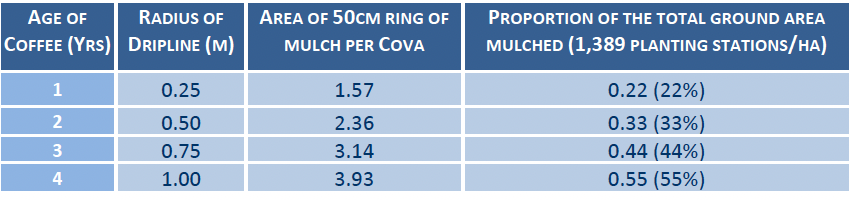
A ring of mulch should be placed in a 0.5m circle just outside the dripline (not against the main stem) soon after planting out and each year for the next three to four years. This method ensures that weeds close to the dripline are controlled, herbicide spray drift is minimised, moisture infiltration into the rooting zone increases and the mulching material available is used economically.
On flatter lands place a 0.3m ring of mulch round the outside of the drip-line for the first two years making sure it is at least 10cm away from the stem. Mulch must be at least 15cm deep (settle to about 10 cm).
On steeper slopes place a 0.75m band of mulch along the lower side of the plant and along the drip-line for the first three years. Mulch must be at least 15cm deep (settle to about 10cm). This prevents erosion and encourages development of a terrace. A small trench at top side of the station, away from the drip line, is a good method to use to prevent run off.
TABLE 10. PROPORTION OF THE AREA MULCHED FOR DIFFERENT AGES OF COFFEE (ASSUMING A SPACING OF 3.0 X 2.4M)
INTER-ROW MULCHING
If mulching materials are in short supply or where microjet irrigation is used, inter-row mulching could be used as an alternative 2 or 3 years after planting. Here the mulch is applied in strips in between the rows which are roughly 1.5-1.6m wide. These strips are still beyond the dripline and away from the plant stems. The mulch should settle to a depth of 10cm. Approximately 38 tonnes of dry material are required to mulch 1 ha of coffee and subsequent mulching should require less as it is mostly a case of topping up. The approach can be considered more economical because it requires considerably less mulching material and the results are almost as good. Timing of applying the mulch is important to save moisture.
SELF-MULCHING
After three or four years if the cova planting system and a high plant population are used, there is the potential for coffee to be self-mulching because the leaf litter from the coffee trees will provide adequate mulch.