7. Keeping Good Records
7.1. Importance of good record keeping in pig management
It is a good management practice for a farmer to keep records. A farmer who does not keep records cannot trace where he/she has been or where he/she is going. The farmer cannot know the financial position of the enterprise or how much investment is going into the enterprise.
By keeping records, a farmer is able to:
1. Track the performance of individual pigs; identifying performers from those that have problems
2. Trace how much is being spent and earned by the enterprise
3. Identify animals for use as Sows and Boars (breeding stock)
4. Compare the performance of the enterprise with that of other farmers 5. Identify which pigs have health and fertility problems
6. Identify weaknesses in management and take corrective action.
7. Compare the performance of pigs with standard production goals.
Standard production goals or targets
A pig farmer should strive to achieve the following goals:-
1. 90% of the sows served becoming pregnant
2. Producing at least 12 piglets per litter
3. Piglets weighing 1.3Kg or more at birth
4. Piglets weighing 11Kg or more at weaning
5. Daily weight gain of at least 0.5kg after weaning
7.2. How to keep records.
There are several types of records which should be kept by a pig farmer. These are briefly outlined below. By keeping these records a farmer can know whether he or she is meeting his production goals or target outlined above. A good farmer should keep the following records.
7.2.1. General record book.
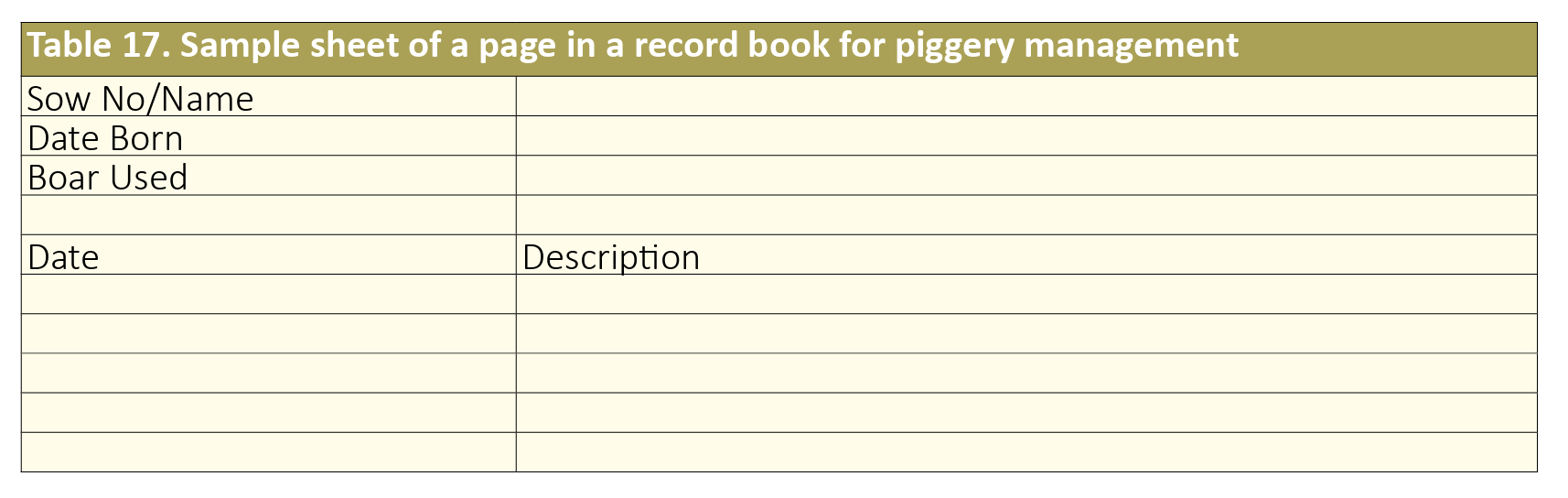
This is a book where a page is assigned to each pig or litter. Keeping this record makes one know how individual pig in the farm is performing. Table 17 is a suggested layout to capture information about individual Sow performance. Please follow it.
7.2.2. Sow record card.
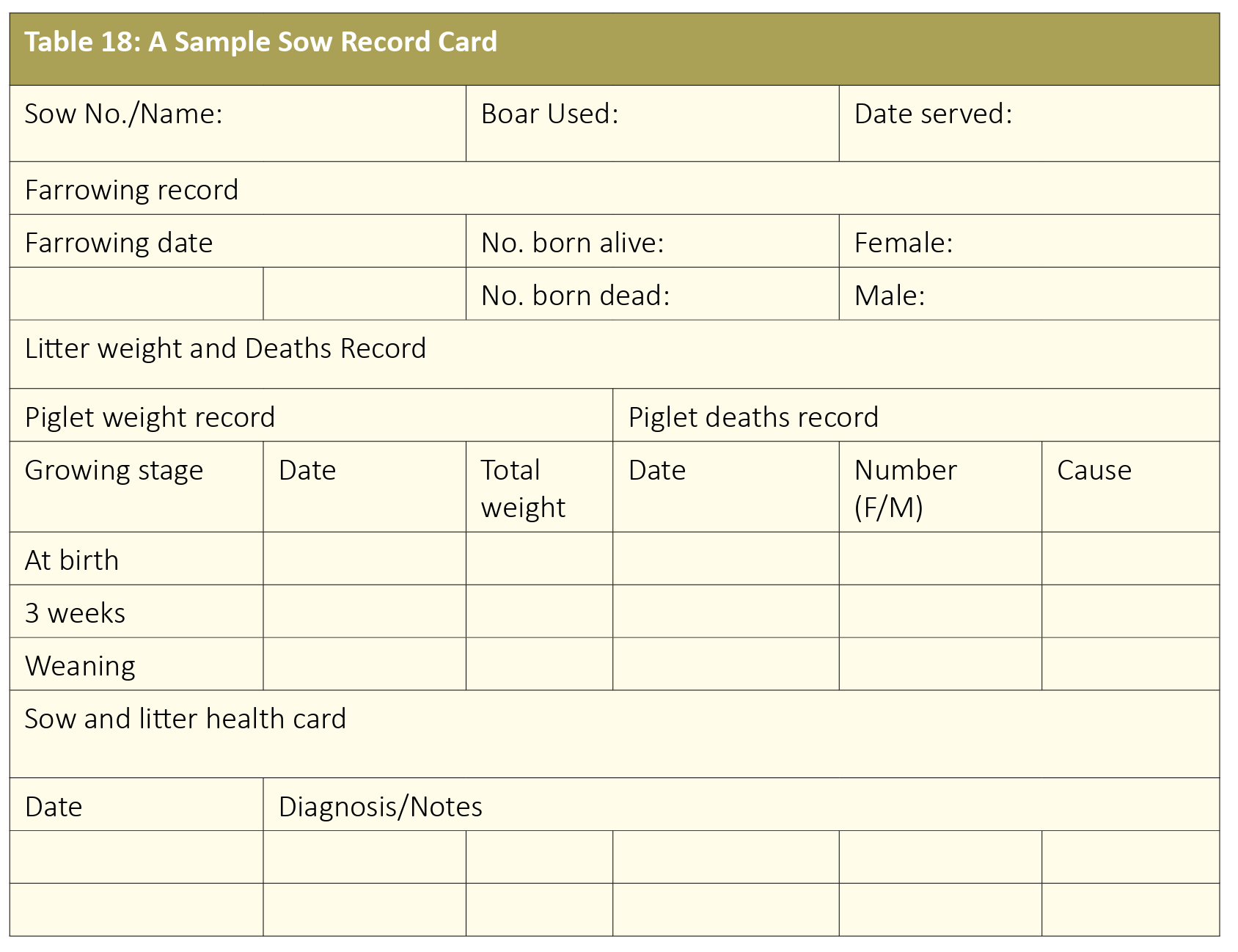
This is a card where vital information on the breeding performance of a pig (a Sow) is kept. The Card is kept safe in a file. The information on the file is useful in monitoring performance of the animal and breed selection. A sample example of a record Card for a Sow is shown in Table 18.
This should show:
• Sow number or name
• The Boar used for service
• Date of farrowing
• Number of piglets born (dead and alive)
• Total weight of piglets at birth, at the end of three weeks and at weaning
• Number of piglets that die before weaning
• Dates and nature of illness and treatment
7.2.3. Growing or finishing record card.
This is used to capture information on groups of pigs kept together such as in a Pen, or similar environments. This record should show:
1. Pen number
2. Weaning date
3. Name or number of grower/finisher
4. Number of growers/finishers in a pen by sex
5. Weekly body weights
6. Total daily feed allocation
7. Dates and nature of illness and treatment
7.2.4. Boar record card.
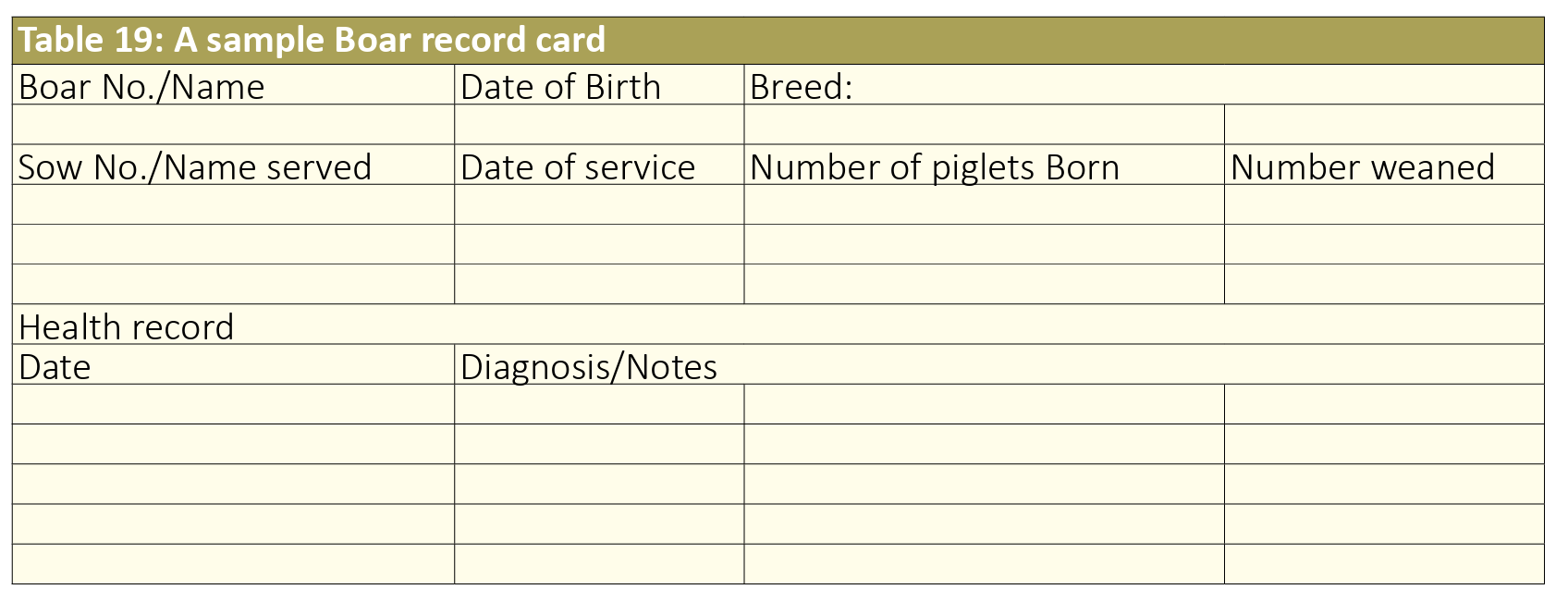
This is a card that keeps records on Boars and their performance. It helps the farmer to know whether the Boar is doing well or not and to take appropriate measures to correct anything that is going wrong. This should show:
1. Boar number or name
2. Date of birth
3. Breed
4. Sow number or name served by Boar
5. Date when Boar served that particular Sow
6. Number of piglets born (dead and alive)
7. Number of piglets weaned
8. Dates and nature of illness and treatment
7.2.5. A Diary.
A diary is important to help the farmer capture important events on the farm. It is not recommended to use memory as a method of record keeping. This method is good when a small number of animals are kept and even then, a farmer my forget the information or lose it altogether with time.
A Diary should show all events and activities that happened on the farm and should contain sufficient information for all important events relating to a pig or litter. A Diary is efficient when:
1. One person is responsible for the entry of information
2. Records are entered as soon as an event takes place
3. All records are kept in one place
4. A filing system is used
5. Records are written on a regular basis
6. Averages and totals are calculated every month
7.2.6. Keeping health record.
Health record is important because it gives the farmer some idea of the status of disease situation on the farm. It also gives an idea on the health status of individual animal and spending on treatment.
The information also helps the farmer to decide which animal to eliminate in order to avoid further disease spread to others or minimize spending on disease control.
A farmer should record down all dates and facts relevant to an animal’s health. This is to:
1. Remind you when to repeat a treatment.
2. Remind you exactly how a disease progressed and how animal responded to treatment 3. Help any veterinarian who visit the farm and wants to know the health history of the animal
7.2.7. Financial records.
Financial records are important because it shows you whether your business is making profit or not. Knowing this information helps the farmer in many ways:
1. It helps the farmer to improve on his or her strategy for profit maximization or loss reduction. 2. It also helps the farmer design a strategy to expand the business or access funding from financing institutions.
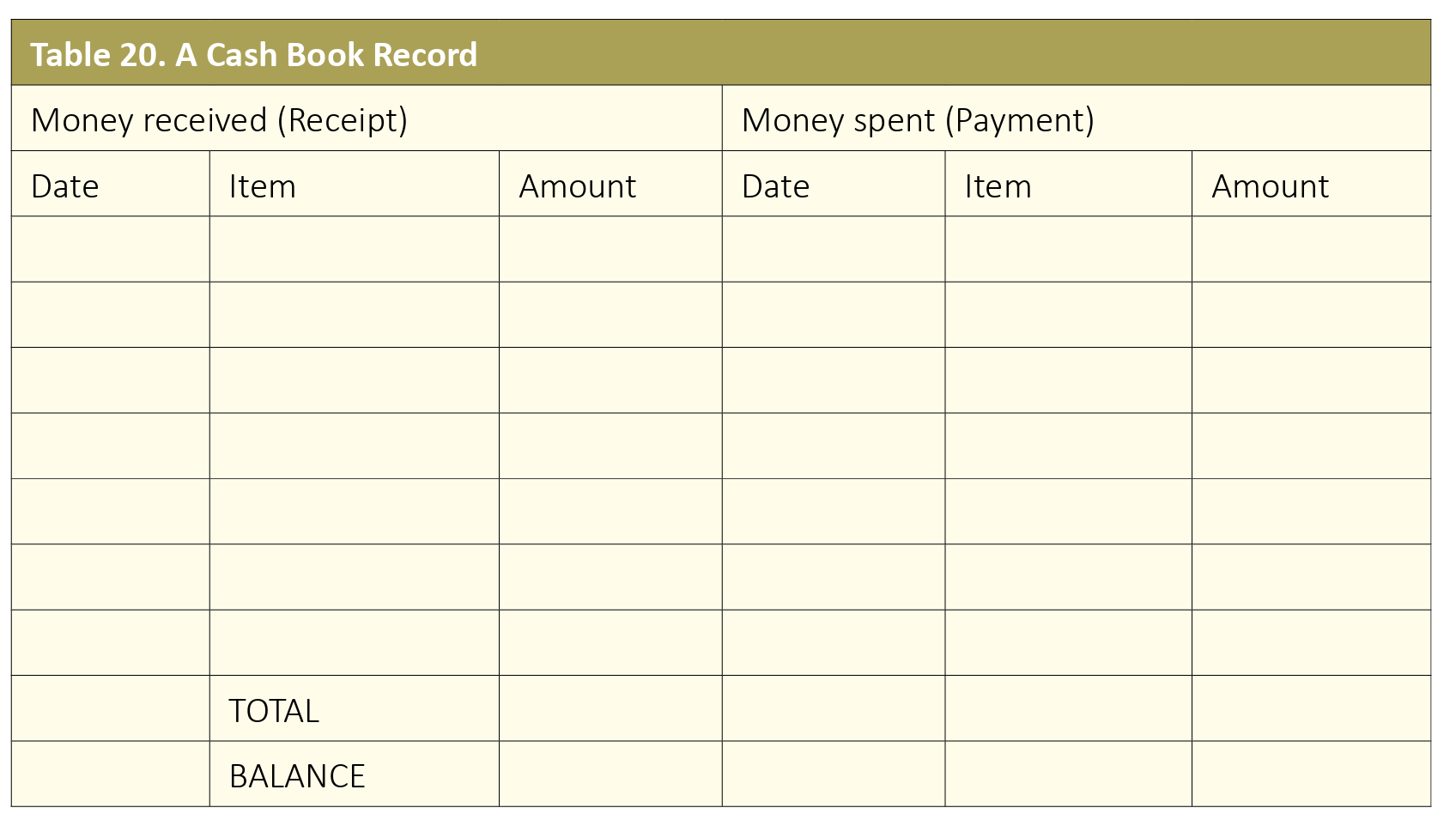
Financial record keeping is a MUST for every enterprising farmer. Each farmer should keep records of all costs incurred and income generated from the business. This record can be captured using a simplified Cash Book (Table 20)
7.2.8. Preparing a summary of records
1. This should be done on a quarterly basis
2. Calculate totals and averages
3. This will help in identification of weak areas in the production process for corrective action 4. It will help identify price trends for future planning
5. Calculate a summary of income and expenditure
7.2.9. Benefits of good record keeping.
Good record keeping can make you see how your pigs are growing, so that you can correct any setbacks. This is well illustrated in 5.6.3.