4. Feeding Management
4.1. Importance of Feeds and Feeding
1. Feed accounts for at least 70% of the cost of commercial pig production. Therefore, it is the most important operational cost item in a pig enterprise. To maximize profits, a pig farmer must minimize feeding costs. Feed must contain the nutrients in the right quantities
2. Pigs require feed for body maintenance, growth and reproduction. Feeds supply nutrients, which are used to meet these biological needs.
3. There are six classes of nutrients required by the pig: water, energy, protein, vitamins, minerals and lipids. These nutrients can be supplied by a wide variety of feedstuffs.
4. Feeding pigs for optimum production requires that feedstuffs be combined in proportionate amounts that will provide the quantities of nutrients needed by the animals.
4.2. Nutrients required by pigs
1. Water: Sixty-five percent of the pig’s body is water. The pig requires water to enable all body functions such as digestion, excretion, blood circulation and maintenance of body temperature. Lack of water quickly leads to a rise in body temperature and death. Also less water will have a major effect on food intake and pig performance. A Sow needs 20 liters of drinking water daily. A farmer should supply clean fresh water all the time.
2. Energy: Provides the body system with the power to function. The energy requirement of the pig is supplied by carbohydrates and fats. The main sources of carbohydrates are cereals, root crops and fruits (Table4). Fats commonly used in pig feeds include groundnuts and soybeans oils, among others. The pig requires very small amount of linoleic acid, an essential fatty acid required for the body’s normal functioning.
Table 4:
Cereal grains
• Maize
• Sorghum
• Millet
• Wheat
Cereal processing byproducts
• Maize bran
• Wheat bran
• Rice bran
Roots and tubers
• Cassava
• Sweet potatoes
• Yams
Fruits
• Banana
• Jackfruit
• Avocado
• Pineapple
• Animal fat is also a good source of energy
3. Protein: Provides the primary blocks for body building and repair i.e meat, collagen, hair and nails. The most commonly used plant and animal protein-containing feedstuffs are shown in Table 5:
Animal protein
• Fish including Mukene
• Blood meal
• Poultry and fish processing wastes
Plant protein
• Soybeans, Beans
• Groundnuts
• Cottonseed cake
• Sunflower seed cake
4. Minerals: These are the nutrients found in bones. Minerals are required for strong bones and normal body function. There are 13 essential inorganic minerals known to be required by the pig. The minerals required in sizeable quantities are calcium, phosphorus, sodium, and chlorine. Iron is very important to the piglet. The common sources of minerals include: lake shells (Obusonko), bone ash, common salt, brown salt, soil and commercial vitamin-mineral premix. Bonemeal, oyster shell and limestone are the most common sources of Calcium and Phosphorus in pig rations.
5. Vitamins are required for maintenance of normal health. Common sources of vitamins for pigs include green leaves and vegetables Table 6:
Name of forage: Sweet potato vines
Local name: Oboke Icok
Name of forage: Elephant grass
Local name: Ebisagazi, ebiyat,
Name of forage: Wondering jew
Local name: Ennanda
Name of forage: Amaranthus
Local name: Dodo, eboga
Other local options: Kafumbe, Ekoropot
Others: Vitamins are vitamin-mineral premix
4.3. Feedstuffs: The Source of Nutrients
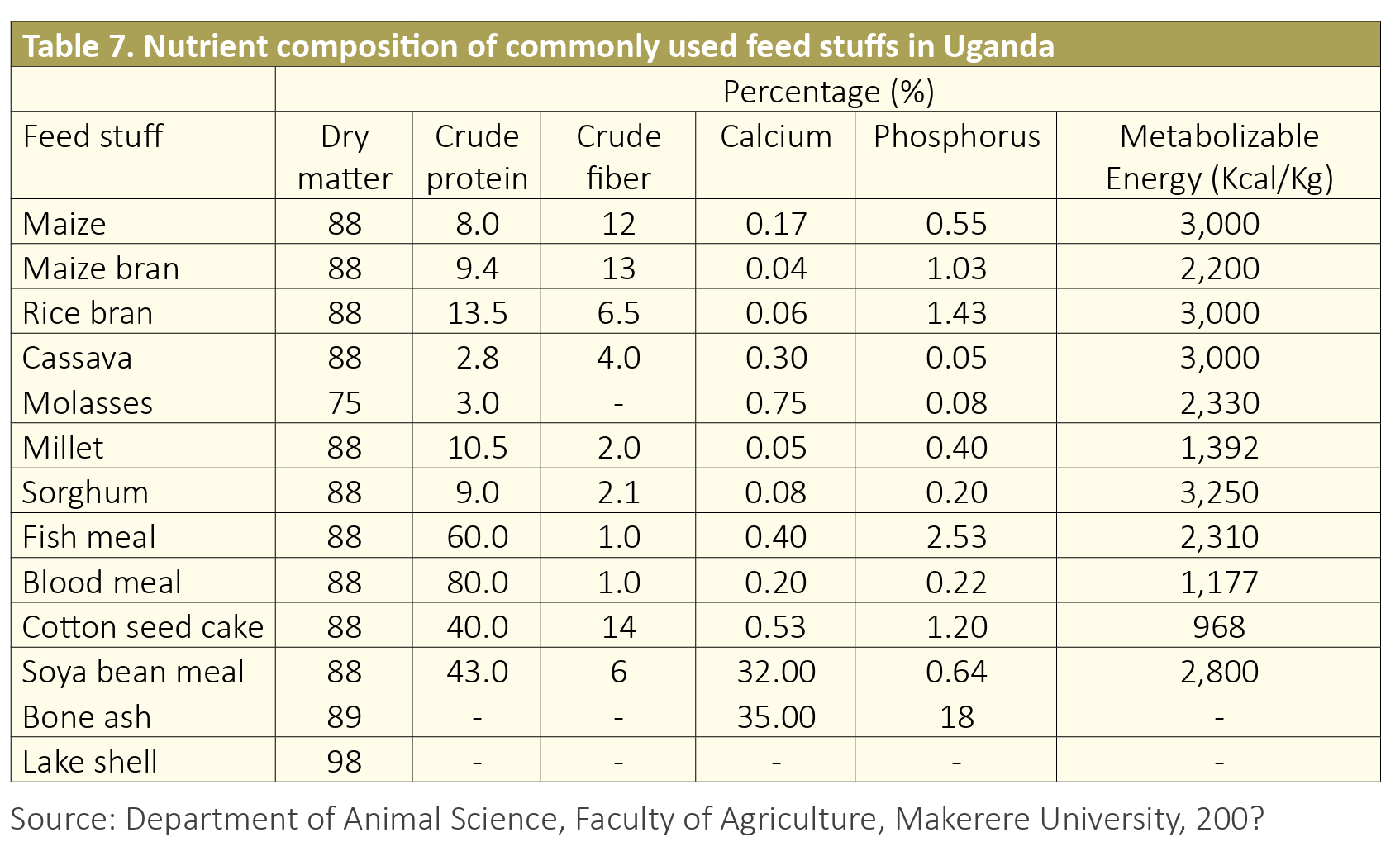
Most natural feedstuffs contain more than one nutrient. A knowledge of feedstuffs locally available to the farmer or pig feed producer is therefore most useful. The list of ingredients and their nutrient composition is shown in Table 7.
It is important to recognize that growth rate on feeds made from low quality feedstuffs is often less than that obtained on feeds formulated from conventional ingredients as shown in Fig. 13. The farmer must therefore carefully consider the economic benefits of using one feedstuff or the other before using them. The nutrient requirement for exotic breeds reared under Ugandan conditions are given in Table 8.
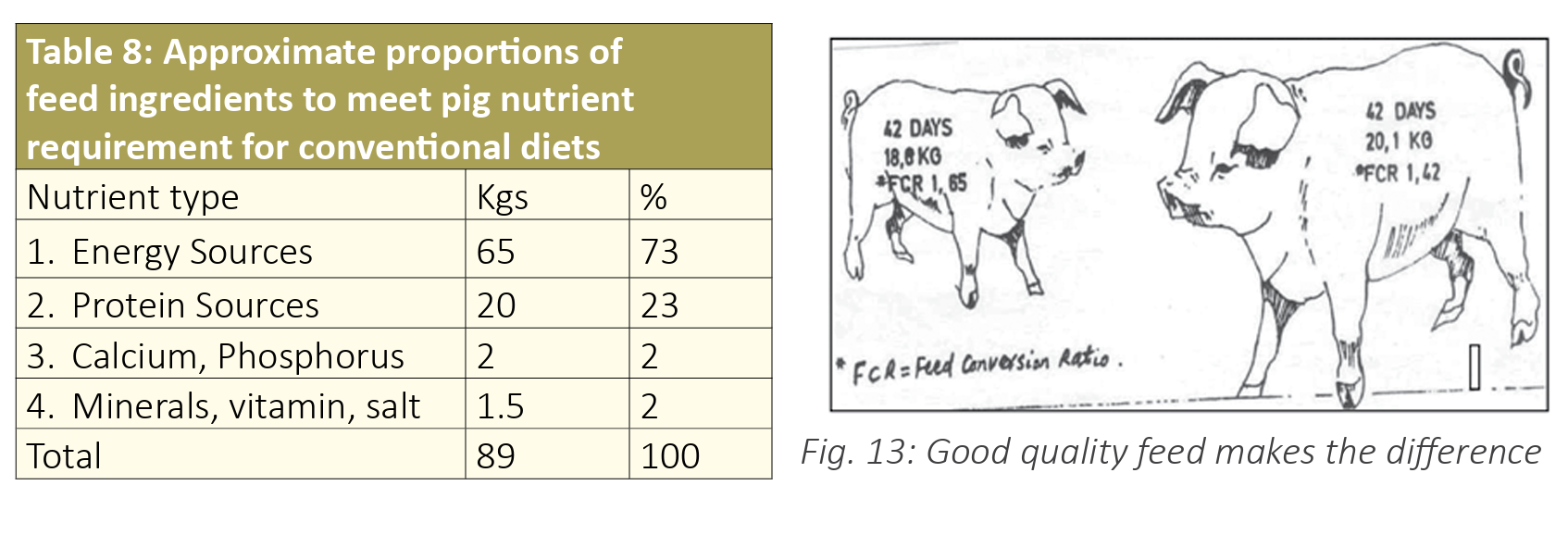
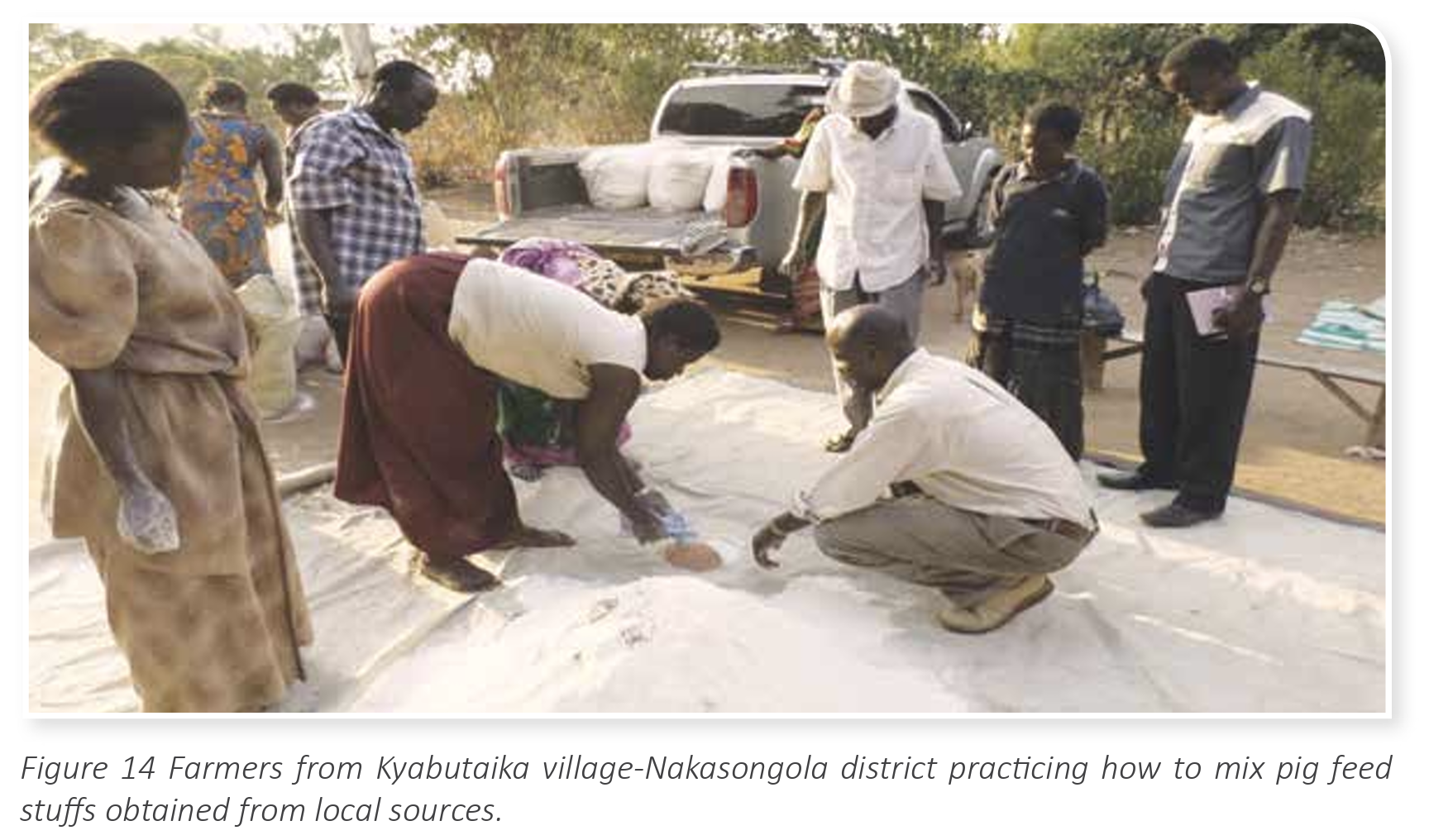
To formulate a ration, the farmer needs information on the nutrient requirement of the animal and the nutrient composition of the feedstuffs available (Table 8). In general, the approximate proportions of feed ingredients to meet pig nutrient requirement, based on own data from Nakaseke and Nakasongola districts are shown in Table 7. This was adapted from standard formulation provided in annex 1.
4.5. Care in feeding pigs.
Farmers should be aware of the importance of good feeding to pigs. They should take great care in ensuring that the pigs get timely and adequate quality feeding. A single feed stuff cannot provide all the nutrients required for all body functions of the pig.
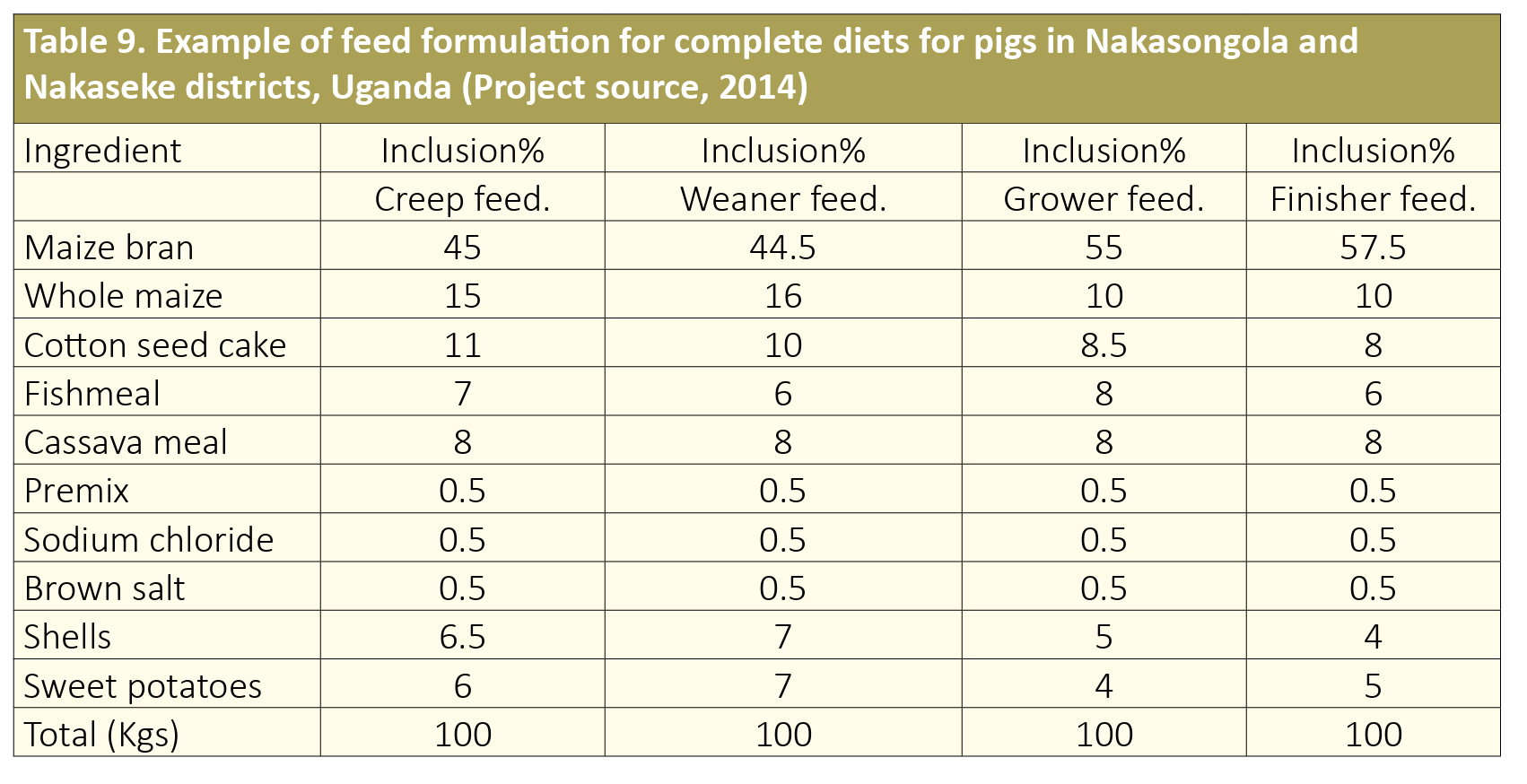
A farmer should therefore mix the different feedstuffs in proportions that satisfy the requirement for a particular type of pig (weaner, piglet or Sow). Table 9 has been developed to guide on this matter.
Although expensive, feedstuffs from animal sources are better than feedstuffs from plant sources since they have better balance of nutrients. Whenever possible, a farmer should include both plant and animal feedstuffs in the ration. S/he should whenever affordable supplement local feed formulation with commercial feed if available. The different feed types are summarized below.
4.6. Types of feed types
Pigs need different types of feeds as they develop because their nutritional needs vary with age and stage of production. There are four types of feeds used in Fermented Bed Technology system. These are: Creep, Weaner, Grower and Finisher feeds.
The choice of which type of feeds to give to your pig depends on the stage of growth of the pig. When to use the different types of feeds and their quality characteristics is summarized in Textbox 3.
Text Box 3. Feed types and quality characteristics
Creep feed:
1. This is introduced to piglets from the third week up to 8 weeks when they are weaned. 2. Creep feed is given to supplement Sow milk
3. It must be high in protein (20-22%) and highly digestible
Weaner feed:
1. This is fed to pigs after weaning from 2-4 month
2. It contains 14-20% protein
Grower feed:
1. This is feed to pigs that are between 4-6 months
2. It is given to breeding animals (gilts, Sows and Boars)
3. It contains 14-16% protein
Finisher meal:
1. It is given to animals after 6 months
2. It contains 11-13% protein
4.7. Sources of pig feeds
1. Purchased from a commercial feed mill or agent.
• These are expensive and require transportation to the farm
• There is no guarantee that the feed contains the nutrients in the correct proportions, so care is needed to check for quality.
2. Made at the farm.
• The feed stuffs are either bought from neighbor home or produced within the farm
• It is formulated at home.
• Prior knowledge of what feed stuffs to use and their nutrient composition is required
• A farmer should know the prices of the different feed stuffs; so s/he can use the cheapest
• A farmer has to know how to remove anti nutritive factors that inhibit proper feed digestion/ utilization if they exist
4.8. Practical feeding basics
Plastic feed troughs are used to feed the pigs. Give the pigs feeds amounting to 4% of their body weight daily. Weigh the pigs every seven days so that you can adjust the feed accordingly. The feed should be given in two equal parts: one half in the morning (9am) and the other half in the evening (5pm). The commercial feed should be supplemented with grass and crop residues which provide vitamins and some minerals. Practical feeding tips for different types of pigs is summarized in Text Box 4 and Text Box5.
Text Box 4. Practical feeding tips for feeding pregnant and lactating Sows and her piglets
1) Feeding during pregnancy
1. For the first two and a half months of pregnancy the daily allowance for the Sow is 3 Kgs
2. The feed intake should be increased gradually by 0.25 kg in the 11th week of pregnancy through to 0.75 kg in the last week of pregnancy. This is called Steaming up
3. Do not over feed. Fat Sows tend to have problems at farrowing
4. A day before farrowing, cut the feed down by a half to avoid constipation
2) Lactating Sow and her piglets
1. The amount of feed given to a Sow depends on the number of piglets in her litter
2. The basic maintenance ration is 3 kg of Sow meal
3. Add 0.25 kg for every piglet in her litter.
4. As an illustration, if her ration is 3 kg and she has 10 piglets in her litter, her daily allowance will be 3+(10 x 0.25) = 5.5 kg per day
5. Divide the feed in two equal parts. Feed one part in the morning and the other in the afternoon
6. Feed greens and roughage in between the two meals
7. From the 6th until the 8th week of lactation, reduce the daily allowance gradually, so that by weaning, she is getting just 3 kg.
8. This gradual reduction helps to dry up the Sow in preparation for weaning
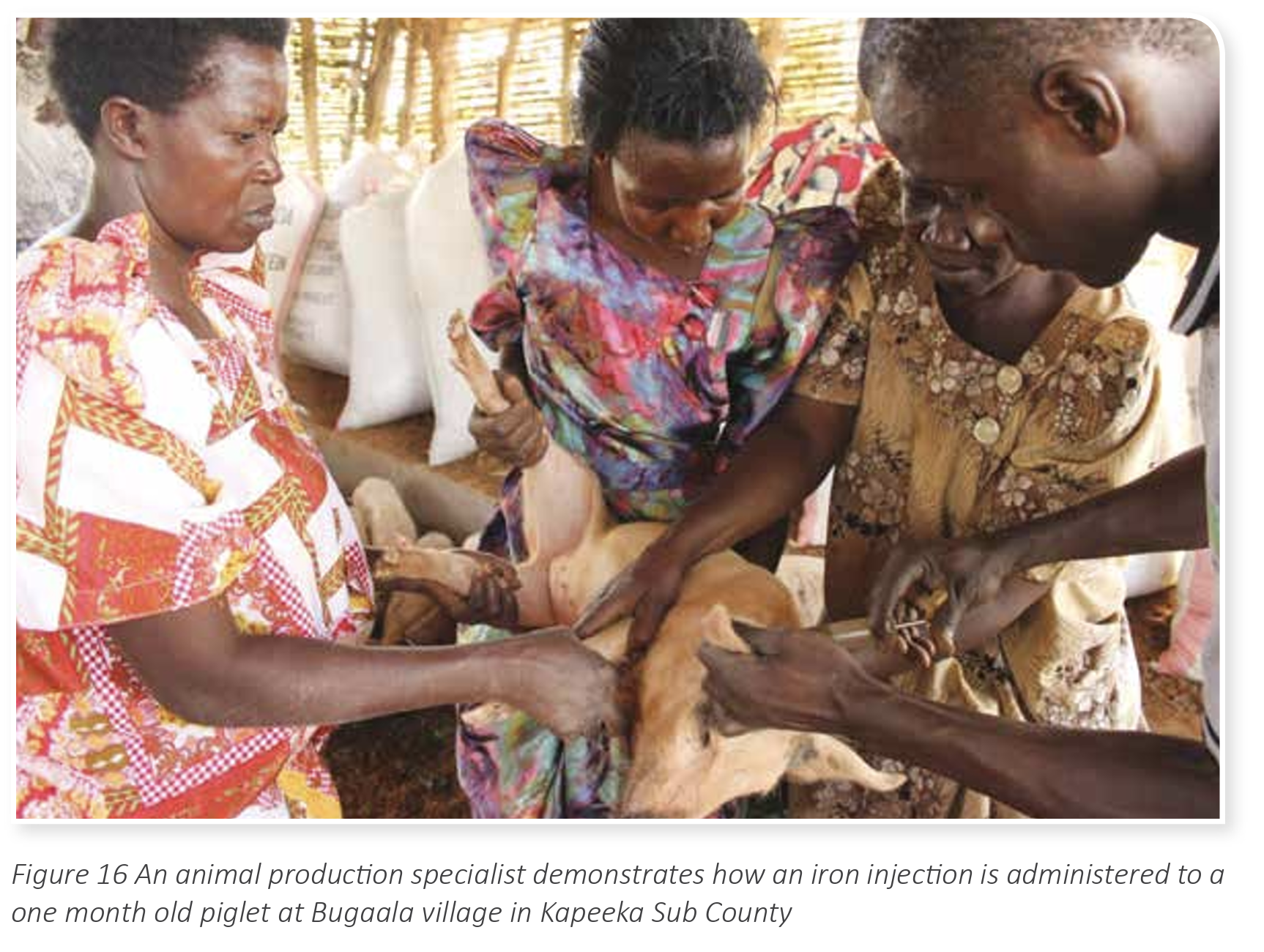
9. Inject piglets with iron on the second or third day after birth
10.Provide creep feed to the piglets 10 days after birth
Text Box 5. Practical feeding tips for feeding pigs at growing and finishing stages
Growing and finishing stages
1. Piglets should average 12 kg at weaning
2. Growing stage is identified as the stage from weaning to about 5 months (60 kg). Such a pig is called a baconer when slaughtered
3. The aim is to maximize lean muscle production and minimize fat deposition
4. Over feeding increases the proportion of fat and this may be unacceptable to the market
5. The amount of feed will depend on weight of the pig
6. Each pig should receive feed equivalent to 4% of its body weight. For example, if a pig weighs 60 kg, it will get 60 x 0.04 = 2.4 kg daily
7. Since growing animals are kept in groups daily feed is obtained by multiplying the feed per pig by the number of animals in the pen
8. For example, a pen holding 15 pigs of 60 kg body weight on average will require (15 x 60) x 0.04 = 36 kg daily
9. Divide the feed in two equal meals to be given in the morning and afternoon
10.Measure the pigs every 7 days to determine new feed ration corresponding to weight gained the previous week.