5. Management of Pigs
5.1. Management of the Boar
Developing Boars. Young Boars should be reared in groups so that they can develop normal sexual behavior. Group rearing presents an opportunity for physical contact and interaction with other pigs during development
Feeding. Young Boars should not be underfed, otherwise their libido and fertility will be reduced. Depending on the age and condition, a young Boar should be fed 2-3 kg of Sow and Weaner meal daily
How to use a Boar for service. A farmer can use one or both of the following mating methods
1. Pen mating. In this method, one Boar is reared with a group of 8-10 Sows. The Boar is left to mate with Sows as and when they come on heat. Pen mating requires less labor. The Boar should be removed from the pen once it is confirmed that all the Sows have been served.
2. Hand mating. In this system, a Boar is kept in a separate pen. Sows on heat are taken to it for service. It ensures that each Sow is mated twice and the exact breeding date is known.
A farmer has to know the signs of a Sow on heat such as the following:
1. Aggressively seeking out a Boar
2. Restlessness
3. Vulva swells and reddens
4. Frequent urination and vaginal mucus discharge
5. Mounting others or when mounted it stands still
6. When pressed on the back by the farmer they stand still
5.2. Management of the Sow.
5.2.1. Key points to note
1. A Sow is a mature female pig. They are the basic units in pig production and therefore should be looked after very well. Sows that are efficient in reproduction make profitable pig herd.
2. Well-managed Sows reach puberty between 4.5 – 6 months. They should be exposed to a Boar at 4 months. Boar smell and noise is known to induce puberty.
3. Delay serving Sows until they are 7 to 8 months old. Serving young Sows impairs their development and productivity
4. Feed adequate quantities of well-balanced diet to Sows for maximum production and delivery of healthy piglets.
5.2.2. Care before a Sow is served
Prior to serving, a farmer should:
1. Allow her a lot of exercise
2. Increase feed allowance to maximize the number of eggs released. This is referred to as flushing
3. Return to the normal ration after mating
4. Allow them to see a Boar at least twice a day
5. Observe for signs of heat at least twice a day
5.2.3. When to serve a Sow on heat.
The AM-PM rule. The farmer should strictly observe the AM-PM rule below:
1. Sows observed on heat in the morning (AM) should be mated in the evening of the same day (PM)
2. Sows detected in the evening (PM) should be mated in the morning of the following day 3. A Sow should be brought back for a second mating twelve hours after the first mating.
5.2.4. Management during pregnancy
1. Ensure good health by maintaining proper hygiene and administering multivitamins and deworming
2. Provide enough space and keep the bedding moist all the time
3. Do not keep more than 10 Sows in a pen
4. A pregnant Sow must not travel long distance.
5. Avoid excessive feeding which makes them too fat. Fat pigs experience difficulties during farrowing
6. Farrowing is expected 114 +/- 3 (three months, 3 weeks and 3 days) days from when the Sow was mated.
5.2.5. Signs of farrowing
The farmers should observe the Sow for the following signs of farrowing:
1. The Sow becomes restless about 24 hours before farrowing
2. There is a distinct swelling of the vulva
3. The teats are turgid and produce small amounts of milk when pressed
4. The Sow begins to dig a hole in the litter as it builds a nest
5. It lies down and abdominal contractions may be noticed
6. A bloody fluid will come out from the vulva
5.2.6. Management during and immediately after farrowing
Day of farrowing. Many piglets may die at this time. Up to 35% of your pigs born alive may die before weaning. The commonest causes of death at this stage are outlined below. These losses can be minimized by having somebody present at farrowing to address the challenges. Although most Sows farrow on their own, others may need to be assisted under the following circumstances
1. When piglets are born with membranes. Such pigs will not start breathing. To induce breathing, the farmer has to clear the membranes away, massage the chest area of the piglet gently while holding the hind legs
2. Sows may kill the piglets by lying on them. Remove the piglets to safety or give “kiss of life” to the piglet if it has been slept on to start breathing
3. Some piglets may be too weak to suckle or fail to locate a teat. The farmer should show and guide such piglets to a teat.
4. The length of the navel cord may be excessively long. Shorten such navel cord by cutting off a piece, and dip the end attached to the piglet in an iodine solution to prevent infection.
Table 11: Important events in Sow management after farrowing
1. First week after weaning, breed the Sow (put the Sow to the Boar)
2. From 111 days to farrowing, observe the Sow for signs of parturition (farrowing)
3. Two weeks before farrowing, treat for internal and external parasites
4. Provide special care for weak or small or small pigs and large litters
5. Cull Sow at weaning on basis of productivity, temperament and other economic factors
6. Recording of events after farrowing. Use a calendar to show these events.
• record the number of piglets born alive and those born dead
• Record the number of female and male piglets
• After identification, weigh the piglets and record the weight of the litter at birth
• At 3 weeks of age weigh the piglets again. Weight at 3 weeks of age gives an indication of the milk-producing ability of the Sow and her mothering ability.
5.2.7. Problems related to farrowing and their solutions.
Problem: Lack of contractions of the uterus (uterine motility)
Solution: Seek veterinary help
Problem: Failure to expel the afterbirth (Retained placenta)
Solution: Seek veterinary help
Problem: Abnormal presentation of piglet within the birth canal (Mal-presentation of piglets)
Solution: A farmer should reposition such piglets using clean disinfected arm with gloves
Problem: Nervous or hysterical Sow/gilts. Such Sows/ gilts stand up and lie down during farrowing and may injure the piglets
Solution: Piglets should be taken away when they are born and returned later when the mother has calmed down
Problem: Partial or incomplete absence of milk flow from the mammary glands. This condition is referred to as Agalactia, and may be caused by: 1. Painful conditions of the teats; 2. Anything, that disturbs milk ejection from the udder 3. Some form of poison from a non-specific infection
Solution: Treat with antibiotics and hormones (e.g. Oxytocin and prolactin). If condition persists consult your veterinary official
Problem: Inflammation of the udder due to infection by bacteria. A condition called Mastitis. The symptoms are: 1. The udder is congested, hot and painful when touched; 2. Sow may not allow piglets to suckle due to pain; 3. There may be no milk secretions or milk let down.
Solution: Control by keeping the pen clean. If the animal has a fever it requires an antibiotic injection
Problem: Inflammation of the uterus due to non specific infection. This condition is referred to as Metritis and it occurs especially in cases of retained placentas, abortion and dead piglets within the uterus. The signs that are usually observed 2-5 days after farrowing include: 1. Fever; 2. Sticky, white-yellow discharges from vulva with foul smell; 3. Arched back due to pain when walking; 4. Slow and uncoordinated movement
Solution: Seek assistance of a veterinarian to: 1. Remove placentas or dead fetus; 2. Flush the genitalia with mild antiseptic; 3. Insertion of uterine tablets of antibiotics (pessaries); 4. Injection with antibiotics
5.3. Management of piglets.
The points outlined in Table 12 are crucial in the management of piglets. A farmer should therefore follow them closely.
Table 12: Crucial Points in the management of piglets
1. Once farrowing is completed a farmer should make sure all piglets are nursing. Any excess piglets for the number of functional teats should be transferred to another Sow. If there is no other Sow, bottle feed the piglet with cow’s milk sweetened with glucose. Transfer at 3-4 days of age while masking odours.
2. Clip the needle teeth, cut the navel cord leaving about 2.5 - 3.5cm (1-1.5 inches) of which should be dipped in a 7% iodine solution.
3. After 2-3 days treat piglets for anemia with 2-3ml of injectable iron. Provide creep feed at 7 days of age. Change feed daily. Treat with iron again after 2 weeks.
4. Deworm after 3-5 weeks and then move Sow and piglets to nursery. If litters are mixed in a nursery, litters should not be more than one week difference in age and do not mix more than four litters per pen.
5. Identify the pigs by giving them names (e.g. Tom, Dick, Harry etc ) or numbers using tattoos, ear tags and ear notching
6. Wean at 56 days (8 weeks). Remember to remove the Sow from the piglets and not vice versa. Deworm piglets regularly. Spray them for lice and mange mites prior to moving them out of nursery at 7-8 weeks.
7. Replace the Sow after the 6th litter or after 4-5 years of age. If its production is still good, leave it until its production falls below the average of the herd.
8. Seek advice from your extension worker/veterinarian wherever possible.
5.4. Other important points in the management of piglets
5.4.1. Castration.
Male piglets are castrated when they are not to be used as Boars. This makes them docile for easy handling. Castration also removes the male smell from their meat. It is important to seek the services of a veterinarian to castrate piglets.
Castration should be done early before piglets grow to 3 weeks of age because:
o The piglet is small and easy to hold
o At this age piglets recover quickly with little impact on growth
o The piglet is well protected with antibodies
5.4.2. Fostering piglets to a Sow.
This involves giving piglets to a Sow other than its own mother. It may become necessary in the event that:
• A Sow dies during or after farrowing
• A Sow falls sick at farrowing and cannot produce milk
• A Sow produces more piglets than the number of teats she has
• A Sow produces an excessively large litter and has poor milking ability
If there is a Sow that has farrowed within 3 days and has more milk and teats that her own piglets:
• Adjust litter size for the number of functioning teats or milking ability of the Sow
• Move the affected piglets to the foster Sow, before they are three days old
• Make sure they have received colostrum from their mother before transferring them
To ensure that the foster Sow does not recognize and reject the fostered piglets, cover the smell of the piglets by:
• Smearing all the piglets including her own piglets with a strong smelling substance like iodine
• Soaking all the piglets thoroughly in a salt solution
• Observe the foster Sow as you go through this process to ensure that it is not battering the fostered piglets
5.4.3. Weaning.
This is the process of separating the Sow from the piglets or removing the piglets from suckling the Sow’s milk. It can be done early (early i.e. 3-5 weeks) or late (i.e. 6-8 weeks).
Under production conditions in Uganda, weaning should not be done early because it requires an expensive diet for the weaners and high management standards, which are a challenge to most of our ordinary farmers.
To avoid exposing the weaners to undue stress, remove the Sow from the farrowing pen and leave the piglets in the pen they are used to for some time. Weaning should be done gradually, probably over a four-day period. Cut back the daily feed allowance to just 3 kg. This helps to dry the Sow off conveniently
Split weaning. This is when piglets are weaned in lots. As an alternative, a farmer may practice split weaning as follows:
1. At the end of week five, remove the piglets that are above average in size from the litter
2. Allow the small piglets to suckle for an extra 4-5 days. This gives them a chance to take more milk and add extra weight. They should not be allowed to suckle beyond 8 weeks
3. Split weaning reduces the intensity of suckling and allows a Sow to come back to heat early after weaning
Rebreeding the Sow after weaning. A healthy well-fed Sow will come to heat within 4 to 7 days after weaning. A farmer should observe such a Sow at least twice a day for signs of heat.
5.5. Recommended targets to achieve.
A good farmer should aim to achieve the targets in the Table 13 below
Table 13: Key targets to achieve in piggery management
1. Reproduction rate – Each Sow should produce 10-11 piglets born alive per litter
2. A Sow should have at least 2 litters each year – i.e. 20-22 pigs born alive per Sow each year
3. Survival rate – At least 85% of pigs born alive should be reared to weaning (17-19 piglets weaned per Sow each year.
4. Growth rate – Aim at 90kg live weight in 170 days with a carcass yield of 77% or 500gms/ day over a lifetime
5. Aim at achieving a food conversion efficiency of 3.5kg
6. Aim at marketing the pigs for slaughter as porkers at the age of 4-6 months when they will have attained market weight 65-100kg
7. Strive to ensure a production life span of at most 5 years for the Sows.
5.6. Monitor the growth of your pigs
5.6.1. Pig weight estimation methods
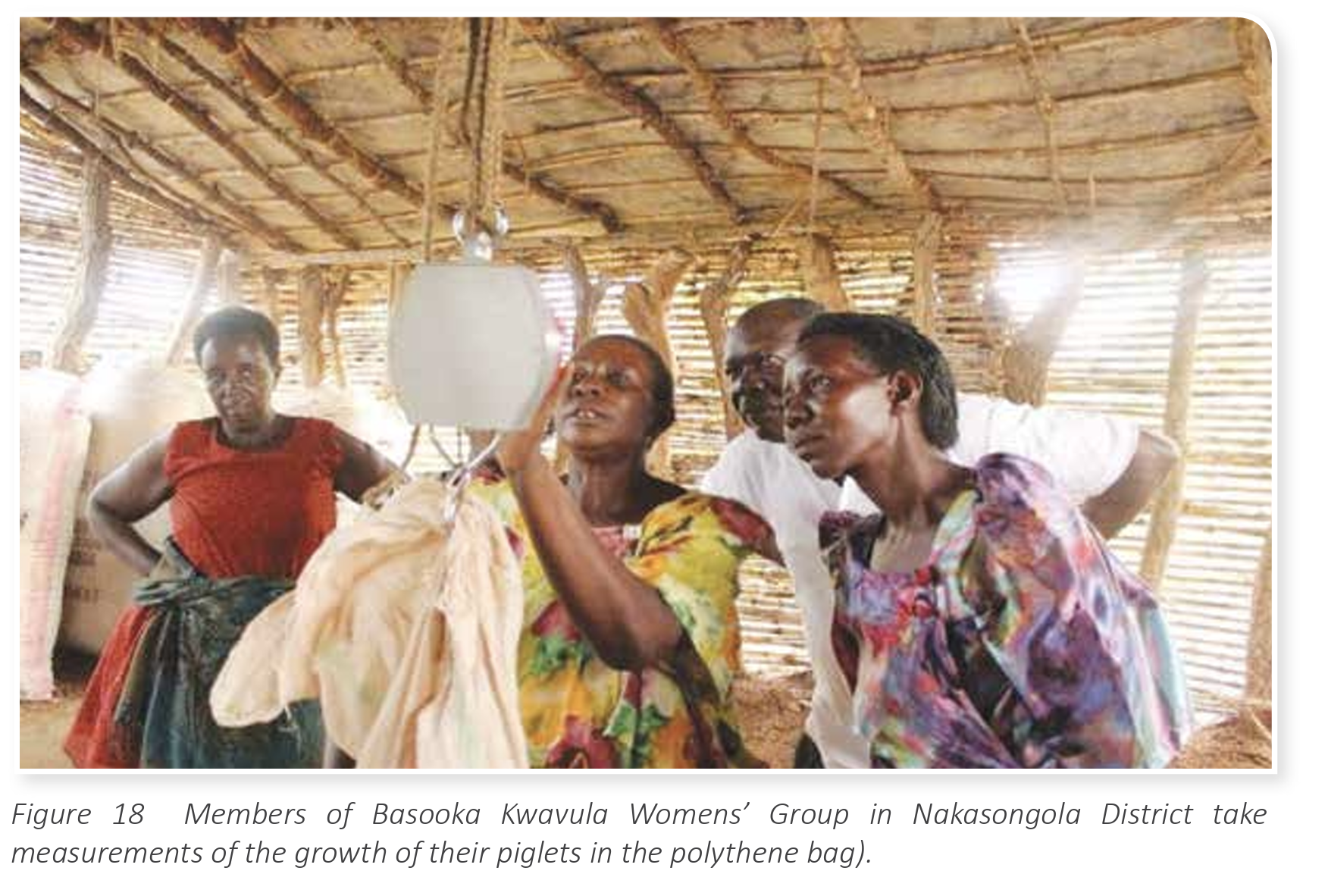
1. The weighing scale method. A commercial weighing scale is the most convenient and accurate method for recording pig weights. As the animals get bigger, weighing with a weighing scale gets more difficult, especially by women. At an appropriate stage, a farmers should shift to the girth method for weighing mature pigs.
2. The girth and length method. This is accurate to within 3% of actual weight. To estimate the weight of the pig in pounds:
1. Measure the heart/girth in inches (marked G)
2. Multiply this measurement by itself (G2)
3. Measure the length of your pig (ears to beginning of tail) in inches (marked L)
4. Then multiply the heart/girth by the length of your pig (ears to beginning of tail) (G2XL)
6. Divide the product (G2XL) by 400 and you will have the approximate weight of the pig in Pounds. Then convert to kilograms by multiplying by 0.4536
7. Summary: Weight (lbs) = {(girth)2 x length}/400
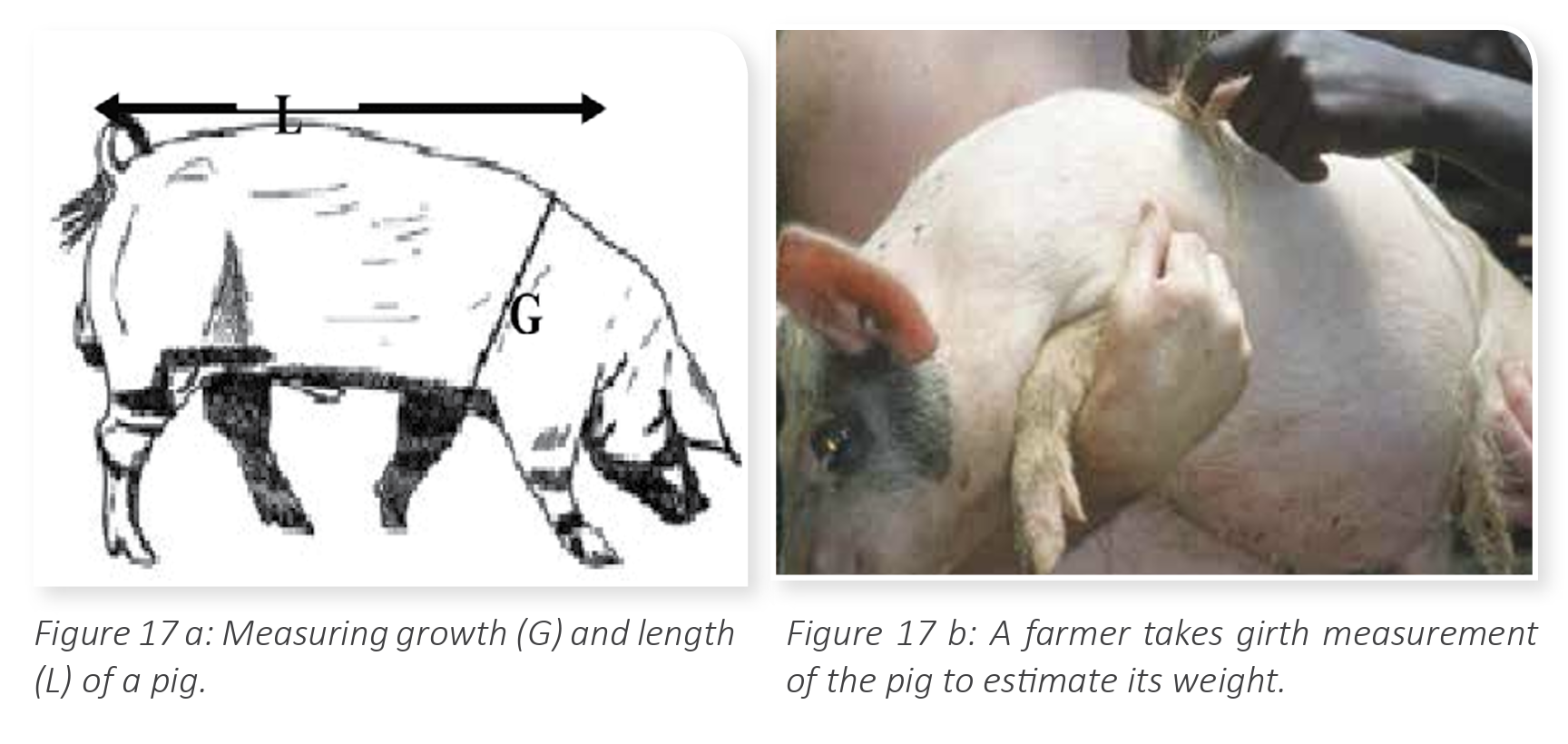
3. The girth only method – metric. A farmer can use the girth-only method to get the approximate weight of the pig. If we take the girth measurement in cm the weight (kg) will be
calculated by:
Weight (kg) = ({4.07 x girth} - 333)
To convert into metric: 1 pound =0.453.59kg; 1 inch is 2.54 centimeters.
5.6.2. Measuring growth of your pigs
Measure the growth of your pigs regularly. This is important so that you know how the pig is growing. Give the pig adequate feed and detect any signs of ill health and treat it.
A farmer should have a record book to capture information such as weekly weight on individual pigs, amount of feeds given, diseases and pest incidences, for each pig. The record book should also indicate how the feed was split between the morning and evening schedules.
Take measurements (girth method or weighing scale) of the pigs weekly. Plot the growth of the pigs on a convenient surface so you can spot out any slowdown.
5.6.3. Growth performance of your piglets
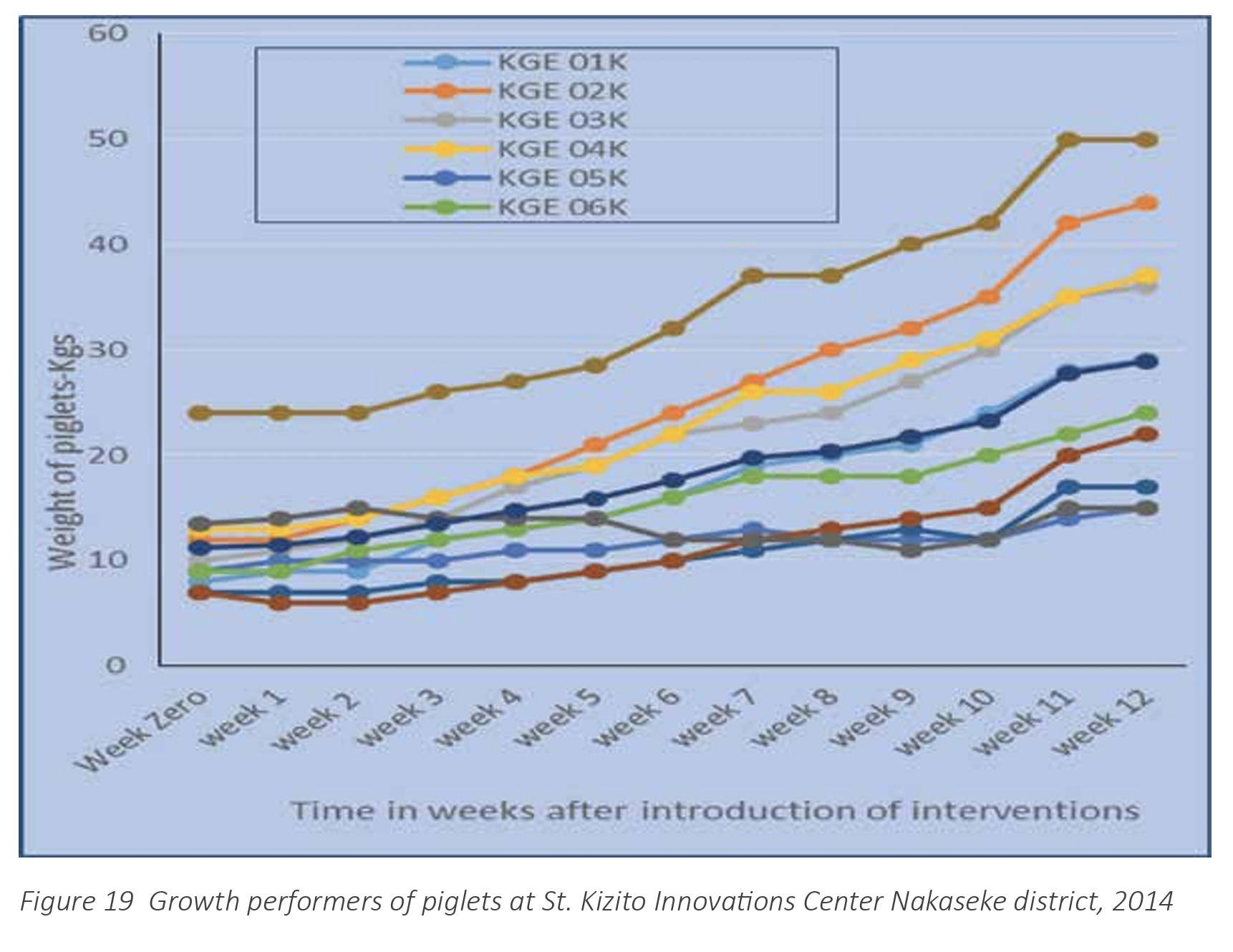
Good record keeping can make you see how your pigs are growing, so that you can correct any setbacks. Figure 19 shows growth performance of piglets from innovations farm of St Kizito Farmers’ Group in Kakooge Sub County Nakasekke district in 2014.
Rate of weight gain varied from 1-7 kg per week depending on the piglet. The male piglet KGE 10K put on 3-4 kg but sometimes up to 7kg of weight per week. Therefore under good management practices, piglets reared using FBT are capable of putting on 5-7kgs of weight per week, resulting in huge gains in profit and time.
If any pig appears to slow down, examine the pig in detail to find out the cause of the slow growth. If necessary feed the pig separately. Treat the pig promptly if there is any signs of ill health. In this case poor performers were isolated and fed separately to minimize bullying for feeds by bigger ones.